About the brand
The essence of the island
A brand that brings from Bali what is purest about the island: the hands of the artisan, the scent of incense and the calm of the rice terraces.
Sari means essence. It is the very word the Balinese use for the heart of their daily offering.
Every morning, canang sari appears on the doorsteps of homes — a small basket of palm leaves, flowers and rice, with incense gently smouldering. Canang is the tray. Sari is the essence — what matters most in the offering, what the smoke carries up to the gods. We did not choose this name by chance: that is exactly what we want to bring from Bali — the essence, not a souvenir.
Our mark is an ear of rice, padi. In Bali, rice is no ordinary grain — it is a goddess. According to myth, Dewi Sri, the goddess of fertility, turned herself into the rice plant, which is why every grain is sacred. The terraces that nourish her are watered by the thousand-year-old subak system, inscribed on the UNESCO list as a living manifestation of the Tri Hita Karana philosophy — harmony between people, nature and the divine. Our mark holds that whole story in nine golden grains.
We work directly with artisans from Ubud and its surroundings — no middlemen, no haste. Every piece of furniture, every basket, every incense stick has its own story and its own maker. For in Balinese art what matters is taksu — the spiritual energy a maker leaves in their work. It is what sets an object with a soul apart from a lifeless copy.
Process
From raw material to object
Material
At the source
Suar wood, rattan and natural resins chosen by hand, at the source — with respect for the forest and the pace at which it grows.
Artisan
One pair of hands
Every object passes into the hands of one person — no production line, no haste, and full responsibility for the result.
Technique
From generation to generation
Weaving, carving, roasting — methods handed down from generation to generation in the villages around Ubud, never hurried by machines.
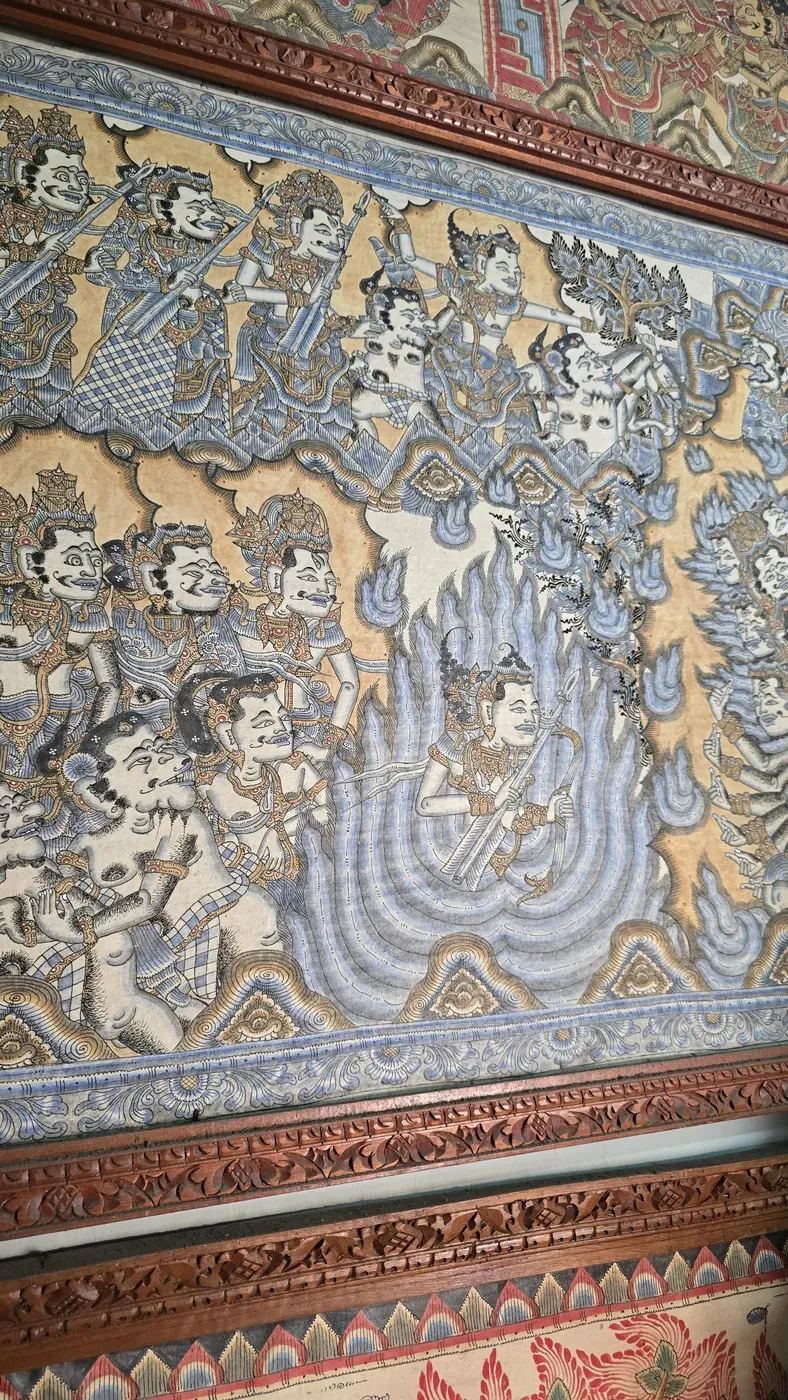
Artisan
I Nyoman Kondra — malarstwo Kamasan
Kamasan, Klungkung, Bali
Kamasan is the only village in Bali still painting in the classical wayang style — scenes from the Ramayana and Mahabharata in natural pigments on cloth. I Nyoman Kondra learned from his father; his paintings hang in the Klungkung palace.
We visited him in August 2026. It is the oldest living school of painting on the island.
Tri Hita Karana
Three sources of harmony
The Balinese philosophy by which a good life — and good craft — is born of the balance of three relationships. It guides us in every choice we make.
parahyangan
With the spiritual
The artisan begins work with an offering and a prayer. An object is born of intention, not haste — and carries the taksu of its maker.
pawongan
With people
Working directly with the workshops, fair conditions, names instead of an anonymous assembly line. Every piece has a face.
palemahan
With nature
Suar wood, rattan and natural resins sourced locally — even the hyacinth that cleanses the lakes before it becomes a basket.