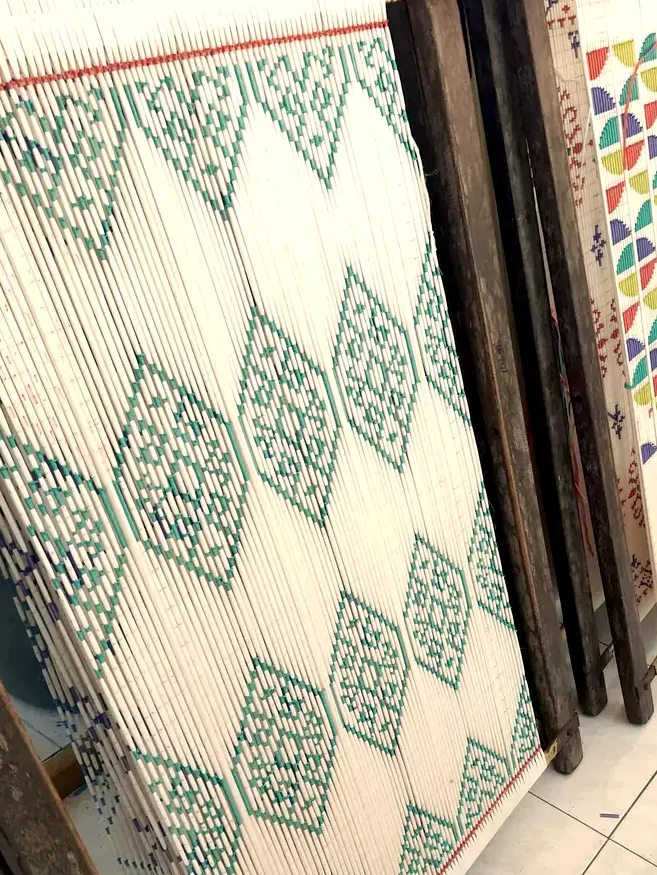
Guide · Craft & interiors
Geringsing — the Cloth That Takes Years to Weave
17 August 2026 · 6 min read
There are fabrics you buy by the metre. And then there is geringsing — the only double ikat textile in all of Indonesia, made in one single village, where a single piece takes not days but years. This is no sales exaggeration. The technique is so difficult that the rest of the archipelago never mastered it.
Meet the cloth that protects, heals, and remembers a time before Bali's greatest kingdom.
A village that remembers the time before Majapahit
Geringsing is made in Tenganan Pegringsingan — a village of the Bali Aga, the indigenous, pre-Majapahit people of Bali. They are the "original" Balinese, living by their own, older rules from before the Majapahit kingdom arrived from Java. Weaving geringsing is part of their identity — you cannot buy it "to go" from any factory, because it is made nowhere else.
Double ikat — the world's most difficult weave
In ordinary ikat, the threads are dyed before weaving, tied off so the dye cannot reach chosen sections — producing a pattern with characteristically "blurred" edges. In single ikat, only one set of threads is dyed — in Balinese endek cloth, it is the weft.
In double ikat, both warp and weft threads are dyed — each separately, tied before weaving with such precision that the patterns from both directions meet exactly in the finished cloth. It is considered the most difficult weaving technique in the world. It is practised in only three places on Earth: in India (patola), in Japan, and in Balinese Tenganan.
Why it takes years
Geringsing dyes are entirely natural, and preparing them is a ritual of time in itself:
- Reddish brown from the root of mengkudu (Morinda citrifolia) — achieving a deep colour requires soaking and drying the threads over and over, cycle after cycle.
- Deep navy from the leaves of indigo (Indigofera) — a dark blue built up in layers.
- Cream — the natural colour of the thread, the third tone of the composition.
The dyeing alone can take half a year or more; bringing everything together into one cloth — two to five years (sources vary; some cite an average of five years for the most intricate patterns). This is why geringsing was never an everyday fabric — it was, and remains, a ceremonial object.
A name that is a spell
Geringsing joins two Balinese words: gering (illness) and sing (not). Literally: "without illness", "against evil". The cloth is believed to have protective power — it is used in rites of passage and is meant to magically shield and heal the wearer. To wear geringsing is to wrap yourself in an intention of health.
The patterns have names of their own: geringsing wayang (figures from the shadow theatre), geringsing batun tuung ("aubergine seeds"), cempaka (the magnolia flower). Their distant ancestors are the Indian patola cloths, brought to the archipelago centuries ago by traders.
It is the same truth we repeat about every object: a thing made by hand, slowly, with intention, carries something no factory can reproduce. For how to tell it apart from imitation, see our piece on genuine Balinese handicraft.
Frequently asked questions
- How does geringsing differ from ordinary batik or ikat?
- Batik is a wax-applied pattern on finished cloth. Ikat means dyeing the threads before weaving. Geringsing is double ikat — warp and weft threads are dyed separately so the patterns from both meet in the cloth. It is the most difficult of these techniques.
- How long does one piece of geringsing really take?
- Sources cite two to five years, depending on the complexity of the pattern. Preparing the natural dyes alone takes months, as it requires repeated soaking and drying of the threads.
- Where does the name "geringsing" come from?
- From the Balinese words gering (illness) and sing (not) — "without illness". The cloth has protective significance and is used in rites of passage.
- Can geringsing be bought outside Bali?
- It is made exclusively in the village of Tenganan Pegringsingan in eastern Bali. Authentic geringsing is rare and expensive for precisely that reason — no factory makes it.
The shop opens in autumn 2026 — the first container is being filled now.
Join the First CircleThe list shops first — 48 h before opening