Guide · Incense & rituals
Balinese Incense — What It Means and How It's Made
10 July 2026 · 6 min read
The first time you wake up on Bali, even before you open your eyes, you sense it: a sweet, resinous smoke drifting over the streets. At this very moment, a few million incense sticks are burning across the island — outside homes and shops, on scooters, on temple walls. Not because they smell lovely. Because on Bali, incense is a daily conversation with the unseen world.
In this article we explain what Balinese incense really is: where it comes from, what it's made of, why it differs from the mass-produced sticks on drugstore shelves — and how to choose incense that carries the true essence of the island.
Smoke that carries prayers
In Balinese Hinduism (Agama Hindu Dharma), incense smoke has a specific job: it lifts prayer and offering upwards, to the world of gods and ancestors. That's why an incense stick never burns "on its own" — it always accompanies an offering, most often a small palm-leaf basket filled with flowers, rice and a morsel of food. That basket is the canang sari, which we explore in a separate piece on Bali's morning ritual.
Even the colours of the flowers are no accident — they are arranged by the points of the compass and the deities assigned to them: white to the east (Iswara), red to the south (Brahma), yellow to the west (Mahadewa), blue to the north (Wisnu). The flowers are beauty offered to the gods, the rice is gratitude for abundance, and the incense smoke is the messenger that carries it all upwards. Without the smoke, the offering "doesn't arrive". Which is why on Bali incense has burned every day, for a thousand years, in every home.
What is real Balinese incense made of?
Traditional incense sticks (dupa in Indonesian) are made from a handful of simple ingredients:
- a bamboo core — a thin stick that holds everything together,
- a binding paste — powdered tree bark (including species from the laurel family) that burns slowly and evenly,
- aromatic ingredients — resins, sandalwood (cendana), dried flowers (frangipani, ylang-ylang), spices and essential oils. The most precious of the resins is gaharu, known worldwide as oud — it forms when a wounded agarwood tree defends itself against a fungus by producing a dark, fragrant resin,
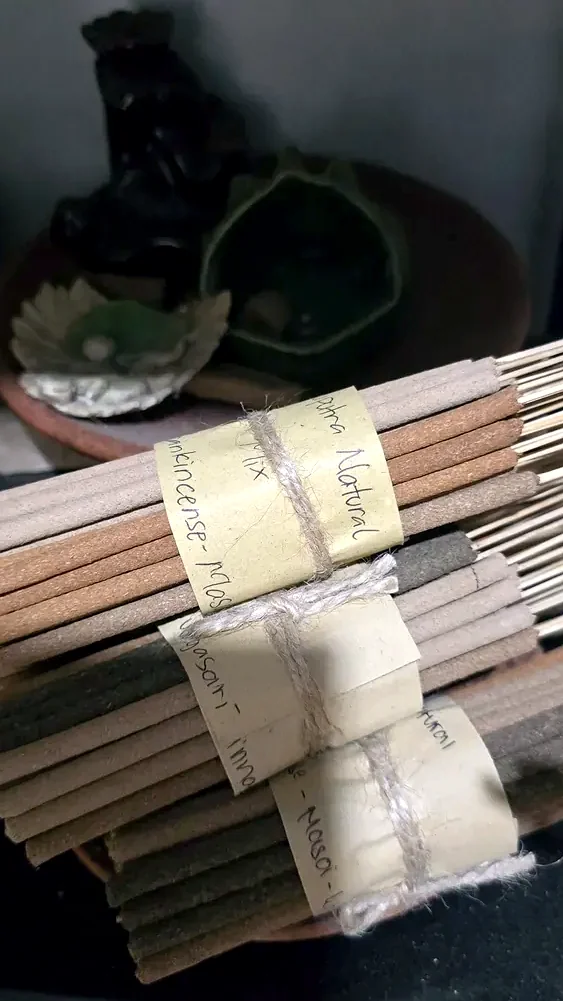
- time and sunshine — the paste is rolled onto the stick by hand, then sun-dried, often on bamboo mats in front of the house.
In small workshops the entire process is done by hand: kneading the paste, rolling each stick between the palms, drying, tying into bundles. One person can make several hundred sticks a day — and every one is slightly different. That's what sets them apart from factory incense: the uneven thickness, the natural colour of the paste, and a scent you can smell before you even strike a match.
How does natural incense differ from synthetic?
Most cheap incense sold in Europe is what's known as dipped incense: ready-made "blank" sticks dunked in synthetic fragrance compounds. They smell intense but flat, and the smoke can catch in your throat.
You can recognise natural incense by a few telltale signs:
- 1.The unlit scent is subtle, herbal and resinous — not "perfumey".
- 2.The smoke is gentle and doesn't sting your eyes.
- 3.The paste has an irregular, matte texture — you can see it was shaped by hand.
- 4.The lingering scent settles into the room softly, with no chemical edge.
It's the same difference we describe in our guide to recognising genuine Balinese handicraft: a thing made by hand always carries a human trace.
How to burn incense at home — a short ritual
You don't have to practise Balinese Hinduism for incense to mean something in your home. Treat it as a signal to your mind: now, we slow down.
- 1.Choose a fixed moment — ideally in the morning before coffee, or in the evening after work.
- 2.Set the stick in a stable holder, away from curtains and draughts.
- 3.Light the tip and let the flame die down — a glowing ember should remain.
- 4.Sit down. One stick burns for 20–30 minutes — a ready-made frame for a moment of calm.
- 5.Air the room afterwards and never leave a burning ember unattended.
Frequently asked questions
- Is Balinese incense safe?
- Yes, with sensible use: a stable holder, a ventilated room, and never leaving the ember unattended. People with asthma should start with short sessions by a slightly open window.
- How long does one incense stick burn?
- Usually 20–40 minutes, depending on the thickness and composition of the paste.
- How should I store incense?
- Airtight, away from light and moisture — ideally in a box or jar. Stored well, incense holds its scent for years.
- What does Bali smell like?
- Most often: frangipani (plumeria), sandalwood, clove and sweet resin. These are the scents that have accompanied the island's offerings for generations.
The shop opens in autumn 2026 — the first container is being filled now.
Join the First CircleThe list shops first — 48 h before opening