Guide · Craft & interiors
Taksu — the Soul That Sets Handicraft Apart from a Copy
24 August 2026 · 5 min read
Take two bowls. The same design, the same dimensions, the same wood. And yet one of them holds your gaze, while the other is merely correct. The West would call it an "aura", or wave it away as subjective impression. The Balinese have a precise word for it: taksu.
It is one of the most important concepts in Balinese art — and the best key to why genuine handicraft moves us while a mass-made copy leaves us cold.
What taksu is
Taksu is spiritual energy, charisma, an inner power that gives a work its soul and makes it captivate. An object or a performance that "has taksu" is alive — it moves the viewer, without anyone quite knowing why. An object without taksu may be technically flawless and yet remain lifeless, "dark", devoid of spiritual wisdom.
The concept spans all the arts: dancer, painter, musician, woodcarver — all of them seek taksu. The state in which a work attains it is called metaksu: the work is then complete not only physically, but spiritually.
The work begins with an offering, not a chisel
On Bali, an artist doesn't simply sit down to work. Balinese carvers begin with an offering and a prayer to Dewi Saraswati, goddess of knowledge and the arts, asking for guidance. Daily ceremonies to "awaken taksu" are as much a part of the craft as the chisel or the brush. Form and motif are drawn from nature — fern, lotus, the rice stalk — because nature here is considered the gods' first work of art.
Developing taksu takes decades, sometimes a lifetime. It is not a technique you can forge in a week — it is something that grows in a person alongside their skill and their humility.
Taksu, not "beautiful imperfection"
The West likes to explain the charm of handicraft through the Japanese idea of wabi-sabi — the beauty of imperfection. But wabi-sabi is Japanese, not Balinese, and it speaks of something else. The Balinese answer to what makes an object alive is not the celebration of flaws — it is the presence of taksu. The point is not that the thing is uneven. The point is that it carries the energy of the person who made it.
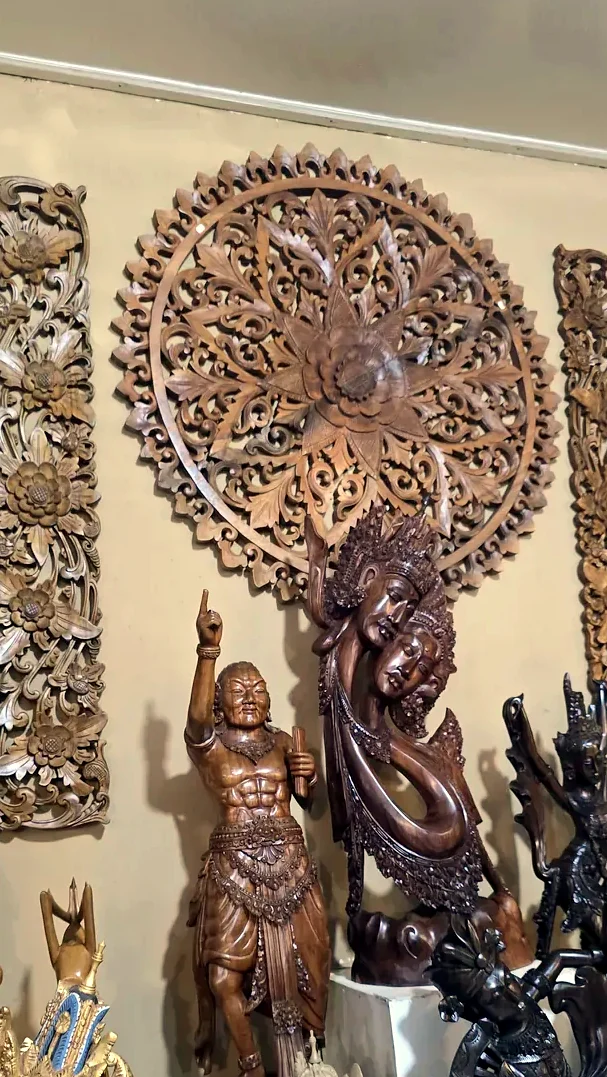
So when we say "every piece has a face", this is exactly what we mean. An object from a workshop carries its maker's taksu. A copy off the line has nowhere to get it from. It is the deepest difference we can name between the two — deeper than the seven signs that reveal an original.
Frequently asked questions
- How do you translate "taksu"?
- There is no single word. The closest: spiritual energy, charisma, the "soul" of a work. It is the force that makes an object or performance move us, even when it could be technically identical to another.
- Is taksu the same as wabi-sabi?
- No. Wabi-sabi is Japanese and speaks of the beauty of imperfection. Taksu is Balinese and speaks of the presence of the maker's spiritual energy in the work — regardless of whether it is smooth or not.
- Does every handmade object have taksu?
- In the Balinese understanding, taksu is born of the maker's skill, intention and spiritual practice — which is why it is associated with the work of masters rather than with every handmade thing. It is the ideal a craftsman strives for.
The shop opens in autumn 2026 — the first container is being filled now.
Join the First CircleThe list shops first — 48 h before opening