Guide · Indonesia & Bali
Importing from Bali: the Journey of a Container from Workshop to a Home in Poland
6 September 2026 · 8 min read
Importing from Bali to Poland is a journey that begins in a craftsman's workshop and ends in a warehouse in Poland, usually taking three to six months. It consists of quality control, packing in crates of ISPM-15-marked wood, consolidation of the cargo, the container's voyage via Singapore to one of Europe's ports, customs clearance in the European Union and overland transport. Each stage has its own documents and rules.
In this article we describe that journey stage by stage: how we choose and check objects on the spot, how they are packed, how a 20-foot container differs from a 40-foot one, what sea freight looks like, which documents must accompany the cargo, what happens at customs, which rules apply to wood, shells, cosmetics and plant products, and why we sell by pre-order. We do not quote costs, because they change from month to month; the times given are indicative.
Stage 1: sourcing and quality control in the workshop
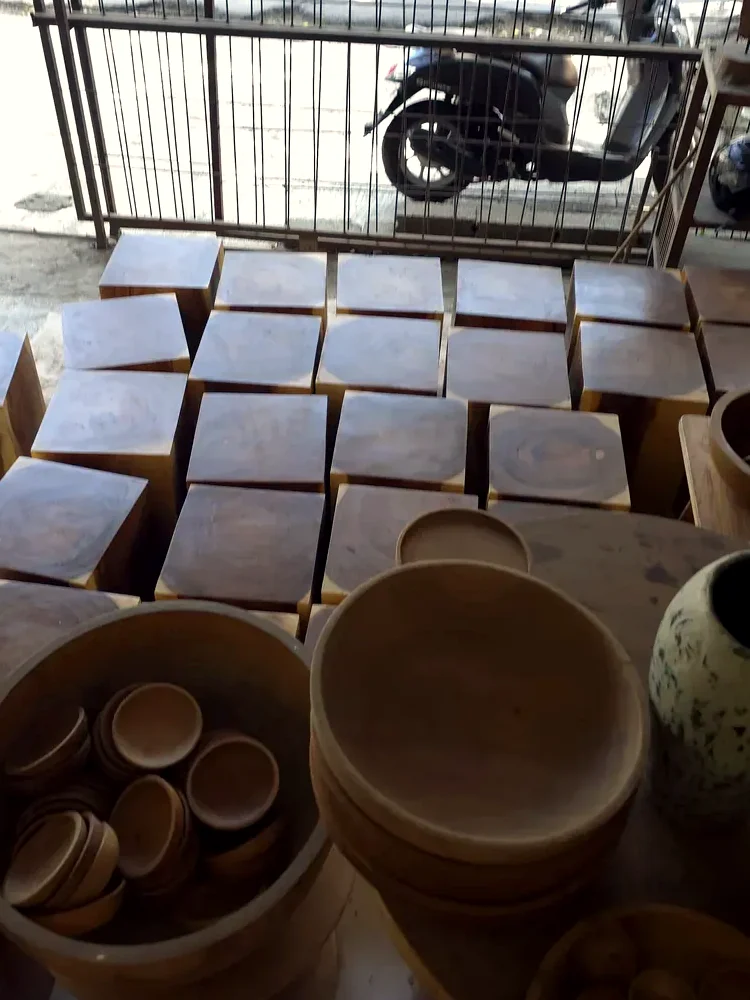
Everything begins with a visit. In August 2026 we toured workshops in Mas, Batubulan, Sidemen, Gelgel and Kamasan, looking not only at finished objects but at how they are made: where the wood comes from, how long it dries, who assembles the weave. With solid wood furniture the key is moisture content: air-dried wood in a tropical climate holds too much for a heated Polish flat, so we ask about kiln drying and measure with a moisture meter; the aim is low teens in percent, not the high twenties. With stone we check for cracks and watertightness, with textiles the fastness of the dyes, with incense the ingredients. At the end comes a photograph of every piece before packing and a pre-shipment inspection, which can be entrusted to an independent inspection company. How to tell handcraft from series production is the subject of a separate piece: craft from Bali and how to spot a fake.
Stage 2: packing and ISPM-15
Furniture and stone are packed in wooden crates or cages, smaller items in cartons with padding. Wooden packaging in international trade is subject to the ISPM-15 standard: the boards must be heat-treated or fumigated and stamped with the IPPC mark carrying the country and facility code. Without that mark a crate can be held at the port and the cargo sent back or destroyed at the importer's expense. Stone basins travel in foam-lined crates on pallets, flat furniture often knocked down, weave and textiles in bags that protect against moisture, because for several weeks a tropical microclimate reigns inside the container. Desiccants go into the container, and before it is closed a packing list with photographs is drawn up.
Stage 3: consolidation and the container
Bali has the small port of Benoa in Denpasar, but most full containers are loaded in Java, at Surabaya (the port of Tanjung Perak), to which goods travel by lorry and ferry across the strait. The forwarder consolidates cargo from several workshops in one place, where the container is loaded, sealed and weighed. A 20-foot container holds about 33 m³, a 40-foot one about 67 m³, and the 40 HC (high cube) version slightly more. A small importer rarely fills a whole container at once, so it either uses LCL groupage, sharing a container with others, or waits to sail until it has enough orders for its own FCL container. The latter is cheaper per cubic metre and safer for the cargo, but it demands patience; and that is the heart of pre-ordering.
Stage 4: sea freight via Singapore
From Surabaya the container sails on a feeder vessel to Singapore, the largest transhipment port in the region, where it is transferred to a large container ship bound for Europe. The classic route runs across the Indian Ocean, through the Red Sea and the Suez Canal to Rotterdam or Hamburg, and increasingly directly to Gdańsk, which receives calls from Asia. The voyage itself is roughly 5–8 weeks, depending on the route, transhipments and the situation in the Red Sea; longer when sailing around Africa. Add to that waiting for a ship in Surabaya and for unloading at the destination port. The documents travel separately: the forwarder issues a bill of lading (B/L), which is at once a receipt for the cargo, the contract of carriage and the document entitling the holder to collect it.
Stage 5: documents and customs clearance in the EU
- Commercial invoice — from the exporter, with value, currency and delivery terms (Incoterms, e.g. FOB Surabaya),
- Packing list — what, in how many crates, of what weight and volume,
- Bill of lading (B/L) — issued by the carrier or forwarder,
- Certificate of origin — confirms that the goods were made in Indonesia; relevant to any tariff preferences,
- Sector documents — a timber legality declaration, a phytosanitary certificate where required, and ingredient declarations for cosmetics and incense.
On arrival at an EU port a customs agent lodges the import declaration on behalf of the importer, who must hold an EORI number. The amount of duty depends on the CN code, the tariff classification of each kind of goods: wooden furniture, stone articles, basketry, textiles and incense have separate codes and separate rates, which we do not quote here because they depend on classification and trade agreements. Import VAT at the national rate is added to the duty, calculated on the value of the goods plus freight and duty. Customs may select a container for physical inspection, which extends clearance by several days.
Which rules apply to objects from Bali?
- Wood: SVLK and EUDR — Indonesia has its own timber legality verification system, SVLK, and was the first country to issue FLEGT licences to the EU. The EU Deforestation Regulation (EUDR) obliges the importer of wood to carry out due diligence with geolocation of the plots the raw material came from; its application dates have been postponed, but the direction is clear. More in our piece on SVLK and EUDR certificates,
- CITES — the convention on trade in endangered species: without permits you may not import articles of hawksbill turtle shell, ivory, coral, giant clam shell or ramin wood, and the agarwood (gaharu) used in incense requires CITES documents. An honest supplier knows what is in the workshop,
- Cosmetics and incense — cosmetics sold in the EU fall under the Cosmetics Regulation (safety assessment, responsible person, CPNP notification), while chemical substances, including fragrance in incense, fall under REACH and CLP rules on registration and labelling,
- Product safety — CE marking does not apply to furniture or handcraft, but it does apply to lamps with an electrical part; all consumer products fall under general product safety rules, which require among other things a responsible person in the EU and identification of the producer,
- Phytosanitary control — applies to plant products; finished, dried and treated rattan and bamboo articles usually need no certificate, but raw material and some forms do, so this is checked before loading. Shells are not a plant product but may fall under CITES.
Stage 6: from the port to the warehouse and to your home
Once released by customs, the container travels by lorry or rail to the warehouse; from Gdańsk that is one day, from Hamburg or Rotterdam two or three. Unloading is the moment of truth: every crate is opened, compared with the packing list and the photographs from Bali, and any damage is documented at once, because claims against the carrier have short deadlines. Furniture acclimatises for a few days before dispatch, wood gets its first coat of oil if it needs one, and only then do the parcels set off to customers.
Timeline of the journey from Bali to Poland
| Stage | Indicative time | Who is responsible |
|---|---|---|
| Sourcing and made-to-order production | 4–10 weeks | workshop, importer (inspection) |
| Packing, ISPM-15, pre-shipment inspection | 1–2 weeks | workshop, inspection company |
| Consolidation, transport to Surabaya, loading | 1–2 weeks | forwarder in Indonesia |
| Sea freight via Singapore to an EU port | 5–8 weeks | carrier, forwarder |
| Customs clearance and inspections | a few days to 2 weeks | customs agent, importer |
| Transport to warehouse and unloading | a few days | haulier, importer |
| Acclimatisation and dispatch to customer | 1–2 weeks | importer |
Why pre-order?
A container is assembled before it sails. Until there are enough orders to fill it completely, every cubic metre of empty space costs as much as a full one, and groupage cargo is handled many times over. That is why we collect orders in advance: the customer orders a piece of furniture, a basin or a figure, we finalise the list with the workshops, and the container leaves when it is full. The delivery time is longer than in a shop with a warehouse, but in return the object is made for a specific person, does not sit in a hall for months, and we pay nothing to store it. Current pre-orders are in the shop, and a comparison of the woods the furniture is made from is in our piece on suar, teak and mahogany.
What this means for the objects in your home
When a suar wood table arrives in a Polish room, it has a dozen pairs of hands behind it: carver, packer, driver, forwarder, customs officer. For every object in the furniture category we state the workshop, the wood species and the indicative delivery date, because we believe a long journey is not a flaw but part of the story, and that it is better told than hidden behind the words “in stock”.
Frequently asked questions
- How long does transport from Bali to Poland take?
- The container voyage alone, from Surabaya via Singapore to a European port, is roughly 5–8 weeks. The whole journey, from the order at the workshop through packing, consolidation, the voyage, customs clearance and transport to the warehouse, usually takes three to six months.
- What is ISPM-15?
- ISPM-15 is the international standard for wooden packaging in trade: pallets, crates and cages. The wood must be heat-treated or fumigated and marked with the IPPC stamp so as not to carry pests. Without that mark a cargo can be held at the port.
- Can I order a container from Bali myself?
- Yes, but it requires an EORI number, a customs agent, forwarders on both sides, knowledge of CN codes and of the rules on wood, cosmetics and protected species, and capital tied up for several months. For a single piece of furniture it is rarely worthwhile; that is where importers and pre-orders come from.
- Is furniture from Bali subject to duty?
- Yes, imports from outside the Union are subject to duty, whose rate depends on the CN code of the goods and any preferences under trade agreements, and to import VAT. The amount is determined by the customs agent at declaration; a customer of a shop in Poland buys goods that have already been cleared.
- What may not be brought from Bali into the EU?
- Without CITES permits you may not import articles from protected species: hawksbill turtle shell, ivory, coral, giant clam shell, ramin wood or agarwood. Wood must have documented legality, and cosmetics a safety assessment and EU notification.
The shop opens in autumn 2026 — the first container is being filled now.
Join the First CircleThe list shops first — 48 h before opening