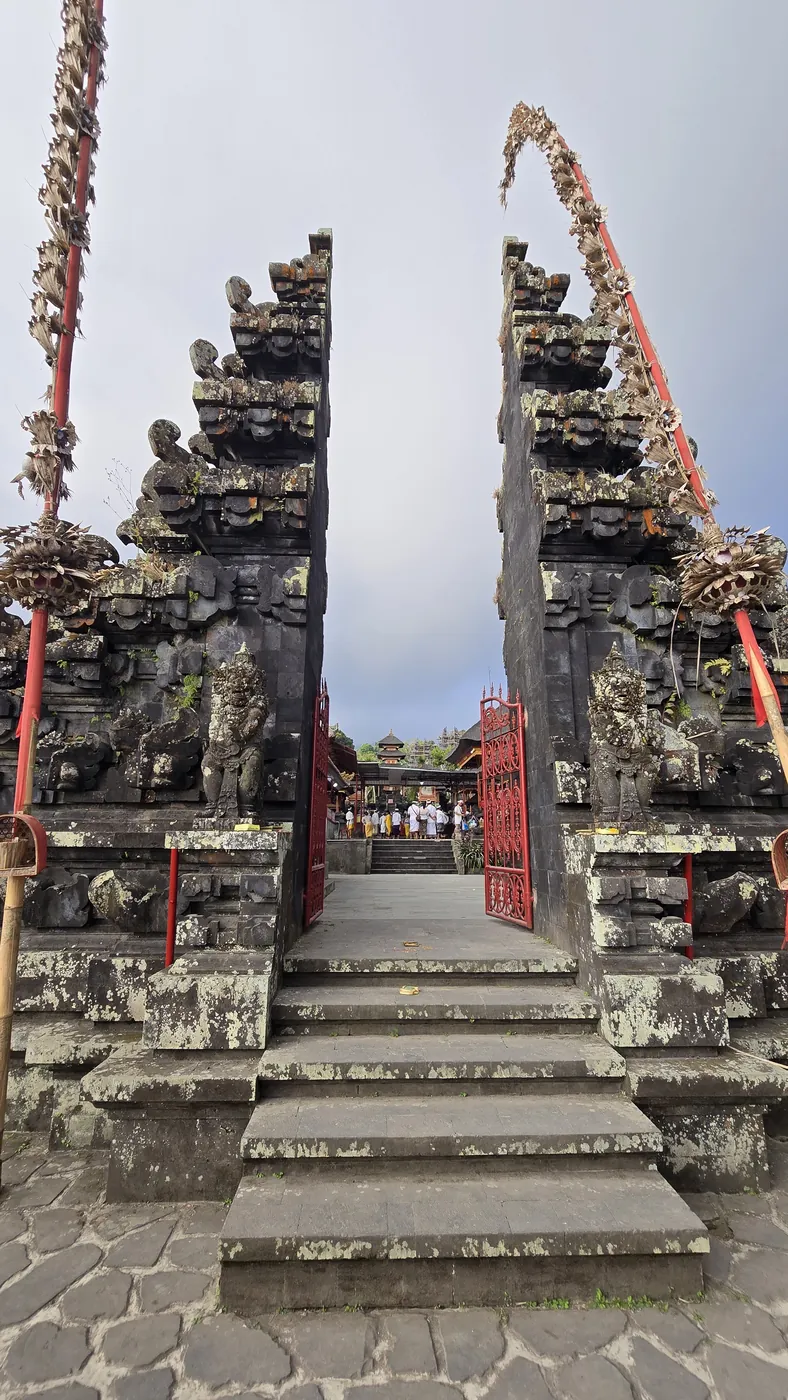
Guide · Indonesia & Bali
The History of Bali: From Majapahit to Today
22 August 2026 · 9 min read
The history of Bali is the story of an island that absorbed influences from Java for more than a thousand years and, after the fall of the Hindu empire of Majapahit around 1500, became the last refuge of its culture. Today Bali is the only Hindu province of a predominantly Muslim Indonesia, and its temples, carving, dances and textiles are the direct legacy of that migration.
This article walks through the key stages of that history: prehistory and the Bali Aga villages, the arrival of Hinduism, Gajah Mada's expedition of 1343, the era of Gelgel and Klungkung, the nine kingdoms, the puputan of 1906 and 1908, the artists of the 1930s, independence, the birth of tourism and the challenges the island faces today.
Who lived on Bali, and where did Hinduism come from?
The ancestors of today's Balinese arrived on the island a few thousand years ago as part of the great Austronesian migration, bringing rice cultivation and metalworking with them. The most famous relic of that age is the Moon of Pejeng (Bulan Pejeng), a huge bronze kettledrum in the Dong Son style, still kept in a temple near Ubud and considered one of the largest surviving anywhere in the world.
The memory of that pre-Hindu Bali survives in the Bali Aga villages (the "original Balinese"), which never adopted the later Javanese order. The best known are Tenganan Pegringsingan in the east, where the double ikat geringsing is still woven, and Trunyan on Lake Batur, where the dead are not cremated but laid beneath a sacred tree.
Hinduism and Buddhism reached Bali by sea, from India and Java, with traders and priests during the first millennium. The oldest dated document from the island is the Blanjong pillar in Sanur from the year 914, erected by King Sri Kesari Warmadewa, the first ruler of Bali known by name. Ties with Java were close: around the year 1000 King Udayana married the Javanese princess Mahendradatta, and their son Airlangga became one of the greatest rulers of East Java. The rock-cut shrines of Gunung Kawi and the Goa Gajah cave date from this period. Balinese Hinduism had its own character from the start, combining Indian deities with the worship of ancestors, mountains and spirits of place; we describe it in our article on Balinese Hinduism.
Majapahit and 1343: why did Bali become Javanese?
The real turning point came with the Javanese empire of Majapahit (c. 1293–c. 1500). In 1343 its famous chief minister Gajah Mada led an expedition that defeated the last king of Bedulu. Majapahit installed its own governor, Sri Kresna Kepakisan, first at Samprangan and later at Gelgel near present-day Klungkung. Javanese priests, craftsmen and artists arrived with the court, and from then on Bali spoke the cultural language of Java.
When Majapahit declined at the end of the 15th century under pressure from the Islamic sultanates of the coast, part of its elite moved to Bali. The key figure of that wave was the priest Danghyang Nirartha, who came to the island in the first half of the 16th century. Tradition credits him with founding the sea temples of Tanah Lot and Uluwatu and introducing the padmasana shrine (an empty throne for the Supreme God). Bali thus became a living archive of a Hindu-Javanese civilisation that was slowly fading on Java itself.
Gelgel, Klungkung and the nine kingdoms
The golden age of Gelgel fell in the 16th century under Dalem Baturenggong, whose influence reached Lombok, Sumbawa and the eastern tip of Java. Literature, dance and painting flourished at court: the nearby village of Kamasan still paints in the wayang style that dates from that time, as we describe in our article on Kamasan painting. At the end of the 17th century a rebellion broke Gelgel, and the court moved a few kilometres away to Klungkung.
The ruler of Klungkung, the Dewa Agung, kept an honorary precedence, but real power dispersed among independent kingdoms. Tradition speaks of nine: Klungkung, Karangasem, Buleleng, Mengwi, Badung, Tabanan, Gianyar, Bangli and Jembrana. They competed, made alliances and fought wars; Karangasem ruled neighbouring Lombok for a long time.
The Dutch, the puputan and the colony
The first Dutch, under Cornelis de Houtman, reached Bali in 1597, but for more than two centuries the island remained on the margins of their empire, of interest mainly as a source of slaves and rice. Only in the mid-19th century did the Netherlands begin its conquest: between 1846 and 1849 three military expeditions broke the resistance of Buleleng, and the north and west of the island passed under colonial control.
The south held out longest. In 1906, on the pretext of a dispute over a plundered shipwreck, the Dutch army marched on Badung. On 20 September 1906 the raja of Denpasar, with his family, court and priests, walked out to meet the military column dressed in white and armed with krises, and died in a puputan, a ritual fight to the end. In 1908 the same happened in Klungkung. The deaths of hundreds of people shocked public opinion in Europe and pushed the Dutch towards a policy of "protecting" Balinese culture, behind which stood an ordinary colonial administration.
The artists of the 1930s, war and independence
In the 1920s and 1930s the first tourists began arriving on Bali, and with them artists and scholars from Europe and America. The most important was the German painter and musician Walter Spies, who settled in Ubud in 1927. Together with the Dutch painter Rudolf Bonnet and the prince of Ubud, Cokorda Gde Agung Sukawati, he founded the Pita Maha association in 1936, which supported Balinese painters and carvers and helped them sell their work; with the dancer Wayan Limbak he also helped create the form of the kecak dance known today. Ubud and the neighbouring villages, including Mas with its carvers, became the centre of the arts they remain today, and it was then that the image of Bali as the "last paradise" was born, partly true, partly invented, but remarkably durable.
The Japanese occupation of 1942–1945 brought hunger and repression. After the proclamation of Indonesian independence on 17 August 1945 the Dutch tried to retake the island; the symbol of Balinese resistance became Lieutenant Colonel I Gusti Ngurah Rai, who died with his entire unit at the battle of Marga on 20 November 1946, and whose name the international airport bears today. The Netherlands recognised Indonesian sovereignty at the end of 1949, and in 1958 Bali became a province in its own right.
The first decades of independence were not easy: in 1963, during the great Eka Dasa Rudra ceremony at Pura Besakih, Mount Agung erupted and killed more than a thousand people, and two years later a wave of political violence that swept through all of Indonesia reached the island and claimed tens of thousands of lives on Bali.
Tourism from the 1970s, and Bali today
The opening of the Denpasar airport to international flights at the end of the 1960s changed everything. In the 1970s surfers and backpackers discovered the beach at Kuta, while Ubud drew those looking for art and quiet. The government built a hotel zone at Nusa Dua, and craft, carving, silver and textiles, turned from a service to temple and court into the economy of whole villages.
The bombings in Kuta on 12 October 2002, which killed 202 people, and further attacks in 2005 showed how much the island depends on tourism, and how it recovers from each crisis, as it did after the volcano and after the pandemic.
| Date | Event |
|---|---|
| 914 | Blanjong pillar in Sanur, the oldest dated inscription on Bali |
| 1343 | Gajah Mada's expedition; Bali under Majapahit rule |
| c. 1500 | Fall of Majapahit; migration of the Javanese elite to Bali |
| 16th century | Golden age of Gelgel; arrival of the priest Nirartha |
| 1906 / 1908 | Puputan in Badung and Klungkung; the whole island under Dutch control |
| 1927–1936 | Walter Spies in Ubud; founding of Pita Maha |
| 1945–1949 | Proclamation of independence; battle of Marga (1946); recognition of sovereignty |
| 1963 | Eruption of Mount Agung |
| 2002 | Kuta bombings |
| 2012 | The subak system inscribed by UNESCO |
Today more than four million people live on Bali, and before the pandemic several million foreign visitors came every year. Alongside tourism, craft remains a pillar of the economy: Mas carves, Celuk works silver, Sidemen and Gelgel weave, Kamasan paints. The challenges are serious, though: water shortages, plastic, traffic, rice fields turned into buildings, and the question of how many visitors the island can take without losing what people come for.
What this means for the objects in your home
When we visited workshops in Mas, Batubulan and Kamasan in August 2026, all of this history was within arm's reach: motifs from Javanese epics in the carvings, the painting style of the Gelgel court, stone guardians like those at temple gates. Sculptures and figures from Bali are therefore not souvenirs of the last few decades of tourism but the continuation of a tradition that survived the fall of Majapahit, conquest and war. Everything begins with curiosity, and the island's history is the best way to understand what you are actually placing on your shelf.
Frequently asked questions
- When did Bali become Hindu?
- Hinduism and Buddhism reached Bali gradually during the first millennium. The oldest dated inscription on the island is from 914, and the decisive moments were Bali's subjection to Javanese Majapahit in 1343 and the later migration of the Javanese elite around 1500.
- What was a puputan?
- A puputan (literally "ending") was a ritual fight to the death in which a Balinese court chose to die rather than surrender. The best-known puputan took place in Badung in 1906 and in Klungkung in 1908, during the Dutch conquest of the south of the island.
- Why is Bali Hindu when Indonesia is Muslim?
- When Java adopted Islam in the 15th and 16th centuries, the Hindu elite of declining Majapahit moved to Bali and preserved their religion and culture there. The island remained Hindu through the following centuries and is today the only such province in Indonesia.
- Who was Walter Spies?
- Walter Spies was a German painter and musician who settled in Ubud in 1927. He co-founded the Pita Maha artists' association (1936), supported Balinese painters and carvers, and largely shaped the image of Bali known from Western art and literature.
- Since when has Bali been popular with tourists?
- The first tourists arrived in the 1920s and 1930s, but mass tourism began after the airport opened to international flights at the end of the 1960s. In the 1970s Kuta and Ubud became destinations, and tourism has been the main pillar of the island's economy ever since.
The shop opens in autumn 2026 — the first container is being filled now.
Join the First CircleThe list shops first — 48 h before opening