Guide · Indonesia & Bali
Pura Besakih: the Mother Temple on the Slopes of Mount Agung
26 August 2026 · 7 min read
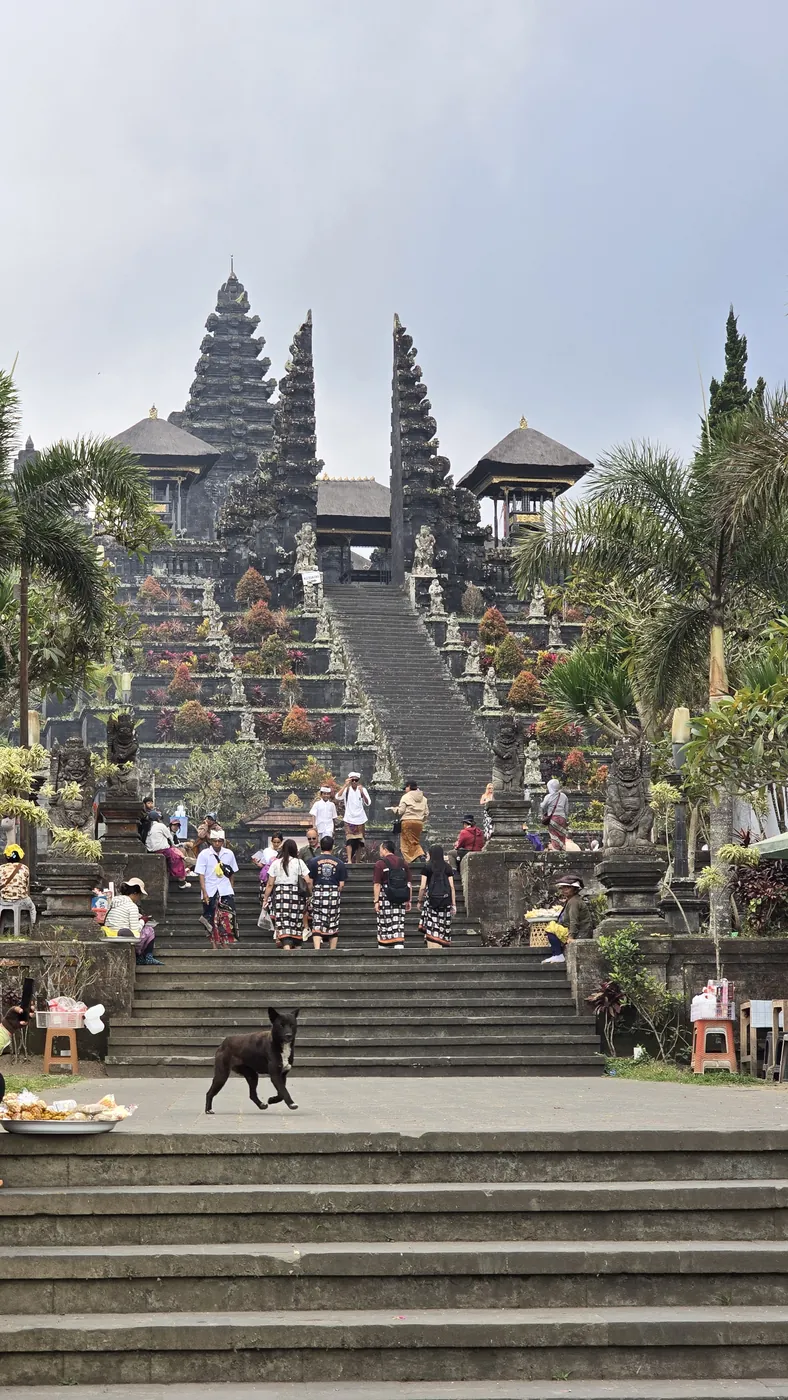
Pura Besakih is the largest and most important temple complex in Bali, set on the south-western slopes of the Gunung Agung volcano at roughly 1,000 metres above sea level, in Karangasem regency in the east of the island. The Balinese call it the mother temple (Pura Ibu): it is the one place of worship that belongs to every inhabitant of Bali regardless of caste, clan or village. The complex consists of more than twenty temples arranged on terraces around the central Pura Penataran Agung.
In this article we explain where Besakih came from and why it stands where it does, what its layout means, how it survived the eruption of Agung in 1963, what the Eka Dasa Rudra ceremony is, and how to visit without disturbing the people for whom it is the home of the gods. We were there in August 2026, so we also write from our own experience.
Why does the temple stand on the side of a volcano?
Gunung Agung, the highest mountain in Bali at over 3,000 metres, is the axis of the world in Balinese cosmology: the seat of the gods and the ancestors, the point towards which house shrines and temples across the island are oriented. The direction "towards the mountain" (kaja) is sacred; the direction "towards the sea" (kelod) belongs to the profane. A temple at the foot of Agung is therefore the island's natural spiritual centre, closer to the gods than any other place.
The site was venerated long before Hinduism arrived. Historians assume that a prehistoric megalithic sanctuary stood on the terraces of Besakih: stone structures older than the temples still stand within the complex, and the stepped terraces resemble mountain sanctuaries known from other parts of Indonesia. Hinduism and Buddhism, which reached Bali from Java in the first millennium, did not replace this cult but absorbed it. The name "Besakih" is often traced to the word basuki ("prosperity, salvation") and to the mythical serpent Naga Basuki, guardian of the world's balance.
How did the complex we know today take shape?
The expansion of Besakih into a great state temple was the work of the kings who ruled Bali from Gelgel, and later from Klungkung, after the fall of Javanese Majapahit. From the fifteenth to the seventeenth century the Gelgel dynasty made Besakih the sanctuary of the whole kingdom: successive rulers added clan temples, and the priests fixed a calendar of ceremonies that is largely still followed. We cover this period in our article on the history of Bali from Majapahit to today.
After the Dutch conquest of the island (1906–1908) and through the years of independent Indonesia, the temple remained a living place of worship, maintained by village communities, clans and the provincial government. Today it is looked after by priests from the surrounding villages, and the cost of the great ceremonies is shared among all the regencies of Bali. This matters: Besakih is not a monument but a working temple where someone is praying every day.
What is inside? The layout of more than twenty temples
Besakih is not a single building but a group of separate temples (pura) linked by stone stairways and paths on the slope. Each has its own courtyards, gates and multi-tiered meru towers thatched with black sugar-palm fibre (ijuk). The most important are the three temples of the Trimurti, the Hindu trinity:
- Pura Penataran Agung — the largest and central temple, dedicated to Shiva; its white banners and terraces lined with meru towers are an image every Balinese knows,
- Pura Kiduling Kreteg — dedicated to Brahma the creator; its colour is red,
- Pura Batu Madeg — dedicated to Vishnu the preserver; its colour is black.
Around them lie the clan temples (pura pedharman), where the individual lineages of Bali honour their ancestors, as well as temples linked to crafts, agriculture and the cardinal directions. The entrance leads through a split gate (candi bentar) and a long flight of steps: symbolically from the profane to the sacred. Visitors see most of the complex from outside and from the outer courtyards; the inner courtyards (jeroan) are reserved for worshippers.
The 1963 eruption of Agung: the lava that spared the temple
In 1963, after more than a century of calm, Gunung Agung erupted. The eruption went on for months, killed more than a thousand people and destroyed villages in the east of the island. Lava flows and ash flows came down the slopes on both sides of the temple, yet the complex itself survived almost untouched. For the Balinese this was no coincidence: they took it as a sign that the gods wished to preserve their home.
The eruption coincided with preparations for the greatest of all Balinese ceremonies, Eka Dasa Rudra, which was being attempted at that very time. The priests read the eruption as a sign that the rite had been scheduled for the wrong moment. It was therefore repeated in 1979, when a century was closing according to the Saka calendar, and it is that ceremony which is regarded as complete and correct.
What is Eka Dasa Rudra?
Eka Dasa Rudra is a ceremony of purification of the universe, performed at Besakih once every hundred years of the Saka calendar. Its purpose is to restore balance between the eleven (eka dasa) directions of the world and Rudra, the fearsome aspect of Shiva. It lasts many weeks and gathers Balinese from the whole island: processions, offerings, gamelan music and dance. The last full Eka Dasa Rudra took place in 1979; the next will be seen only by the following generation.
Beyond this great rite, something is almost always happening at Besakih. Each of the twenty-odd temples has its own anniversary festival (odalan), and once a year, around the full moon of the tenth Balinese month (usually March or April), the temple celebrates Bhatara Turun Kabeh, "the descent of all the gods", when pilgrims from across the island arrive for several weeks.
How to visit Besakih with respect
Besakih is first a place of prayer and only then an attraction. A few rules that apply in every temple in Bali carry particular weight here:
- Sarong and sash (selendang) — compulsory for women and men; they can be borrowed at the entrance, but bringing your own is a gesture of respect,
- Do not enter the inner courtyards during ceremonies — watch from a distance, never stand higher than the priest, and do not walk in front of people praying,
- Women who are menstruating do not enter the temple — this rule applies to every pura in Bali and stems from the concept of ritual purity; the same applies to anyone with an open wound or in mourning,
- Do not climb on walls or shrines, do not touch offerings, and do not fly a drone without permission,
- Dress modestly — shoulders and knees covered, even under the sarong.
For some years now the complex has had a separate visitor area with parking, ticket desks and shuttle buses up to the temple; the ticket includes a local guide who shows the way and keeps an eye on the rules. It is worth using them: they will explain which courtyards are open on a given day and where prayers are under way.
How to get there and when to go
Besakih lies a few dozen kilometres north-east of Denpasar; from Ubud the drive takes 1.5 to 2 hours, either via Semarapura (Klungkung) and Rendang or through the Sidemen valley, which is itself one of the most beautiful routes on the island. The easiest option is to hire a car with a driver for the day and combine Besakih with Sidemen (weaving) and Kamasan (painting), as we did.
The best time is early morning in the dry season (April to October): clouds usually wrap Agung by midday, while in the morning the summit is often clear and the light is soft. Full-moon (purnama) and new-moon (tilem) days are ceremony days, busier but also more genuine. Rain in the wet season is no obstacle if you have a jacket, though the stone steps can be slippery.
What this means for the objects in your home
At Besakih incense smoke rises without pause, from every offering and at every shrine. It is the same gesture the Balinese repeat daily at home: a lit stick turns an offering into a prayer. The herbal incense in our shop is made in small Balinese workshops from the same raw materials that burn on the temple terraces: sandalwood, resins and dried flowers. We describe how it is made and what it means in our article on the meaning of Balinese incense, and the philosophy behind it in our piece on Balinese Hinduism and Tri Hita Karana.
Frequently asked questions
- How many temples are there at Pura Besakih?
- The complex is made up of more than twenty separate temples (23 is the figure most often given), arranged on terraces around the central Pura Penataran Agung. Three of them correspond to the Hindu trinity: Shiva, Brahma and Vishnu.
- Can tourists enter Pura Besakih?
- Yes. Visitors move along the paths and outer courtyards wearing a sarong and sash, usually accompanied by a local guide. The inner courtyards are open only to worshippers, and parts of the complex may be closed during ceremonies.
- Was Besakih damaged in the 1963 eruption of Agung?
- The eruption killed more than a thousand people and destroyed nearby villages, but the lava flows passed on both sides of the temple and the complex survived almost untouched. The Balinese took this as a sign of the gods’ favour.
- When is Eka Dasa Rudra held?
- Once every hundred years of the Saka calendar. The 1963 attempt was interrupted by the eruption, and the full ceremony took place in 1979. Every year, around the full moon in March or April, the temple celebrates Bhatara Turun Kabeh, a great pilgrimage festival.
- How do I get to Pura Besakih from Ubud?
- By car with a driver in 1.5 to 2 hours, via Klungkung and Rendang or through the Sidemen valley. Set off early, before clouds hide the summit of Agung, and combine the visit with the weaving workshops of Sidemen.
The shop opens in autumn 2026 — the first container is being filled now.
Join the First CircleThe list shops first — 48 h before opening