Guide · Indonesia & Bali
Balinese Hinduism: Tri Hita Karana and a Life in Harmony
24 August 2026 · 8 min read
Balinese Hinduism (Agama Hindu Dharma) is the religion of most people on Bali: a form of Hinduism that over the centuries fused with ancestor worship, animism and Buddhism into a system unlike any other. At its heart is belief in one Supreme God, Sang Hyang Widhi Wasa, and the principle of Tri Hita Karana: harmony between people and God, between people and each other, and between people and nature.
In this article we explain what the Balinese believe, what Tri Hita Karana means, how the two Balinese calendars and the main festivals work (Nyepi, Galungan, Kuningan, Saraswati), how a temple is built and what the three temples of every village are, why canang sari is offered every day, how caste and the ceremonies of life, including the ngaben cremation, look in practice, and what all this means for a visitor to the island.
What do the Balinese believe?
At the top stands Sang Hyang Widhi Wasa, the one, unimaginable God, represented symbolically as Acintya (a golden figure surrounded by flames) or as the empty padmasana throne in a temple courtyard. His manifestations are the gods known from India, above all the Trimurti: Brahma (the creator), Vishnu (the preserver) and Shiva (the destroyer and renewer), as well as the deities of the directions, the mountains, the sea and rice, such as Dewi Sri, goddess of rice and fertility.
Beneath that Indian layer lies an older one: the worship of ancestors, spirits of place and the forces of nature. Every Balinese house has its own family shrine (sanggah or merajan) where deified ancestors are honoured. The world is divided into the visible (sekala) and the invisible (niskala), and the balance between the forces of order and chaos, rwa bhineda, "the two opposites", matters more than the victory of either. Hence the black-and-white checked poleng cloth wrapped around statues and trees: a reminder that one cannot exist without the other. How this system came to the island from Java is told in our history of Bali.
What does Tri Hita Karana mean?
Tri Hita Karana means literally "the three causes of well-being". The philosophy, formulated in its present shape in the 20th century but rooted in much older practice, says that a good life depends on three harmonies:
- parahyangan: harmony with God: prayer, offerings, temples, ceremonies,
- pawongan: harmony between people: family, the village community (banjar), mutual help,
- palemahan: harmony with nature: land, water, plants and animals, which have festivals of their own.
This is not an abstraction. Tri Hita Karana organises the layout of a house (the shrine in the holiest corner, towards Mount Agung), the plan of a village and even water management: the subak system that shares water among the rice terraces was inscribed by UNESCO in 2012 precisely as an expression of this philosophy. More in our article on the rice terraces and subak.
How do the Balinese calendars and festivals work?
Bali lives by two calendars at once. The pawukon counts 210 days divided into thirty weeks (wuku) and sets most temple and family festivals, including birthdays (otonan), celebrated every 210 days. The saka calendar is lunisolar, counts its years from 78 CE and determines, among other things, Nyepi, the Balinese New Year.
| Festival | Calendar | What happens |
|---|---|---|
| Nyepi | saka (usually March) | Day of silence: no fire, work, travel or entertainment; ogoh-ogoh parades the evening before |
| Galungan | pawukon (every 210 days) | Victory of dharma over adharma; the ancestors visit their homes; penjor poles go up in front of houses |
| Kuningan | pawukon (10 days after Galungan) | Farewell to the ancestors; offerings of yellow rice |
| Saraswati | pawukon (every 210 days) | Festival of knowledge: books, manuscripts and tools of learning are blessed |
| Odalan | pawukon (every 210 days) | Anniversary of each temple: decorations, offerings, gamelan music, dance |
Nyepi is unique in the world. The evening before, villages carry ogoh-ogoh, giant demon effigies, through the streets and burn them at night. Nyepi itself is a day of total silence: no fire or light may be lit, no work done, no travel, no entertainment. The airport is closed, the streets are empty and the night, for the only time in the year, is truly dark. The rules apply to everyone, hotel guests included.
How is a temple built, and what are the three village temples?
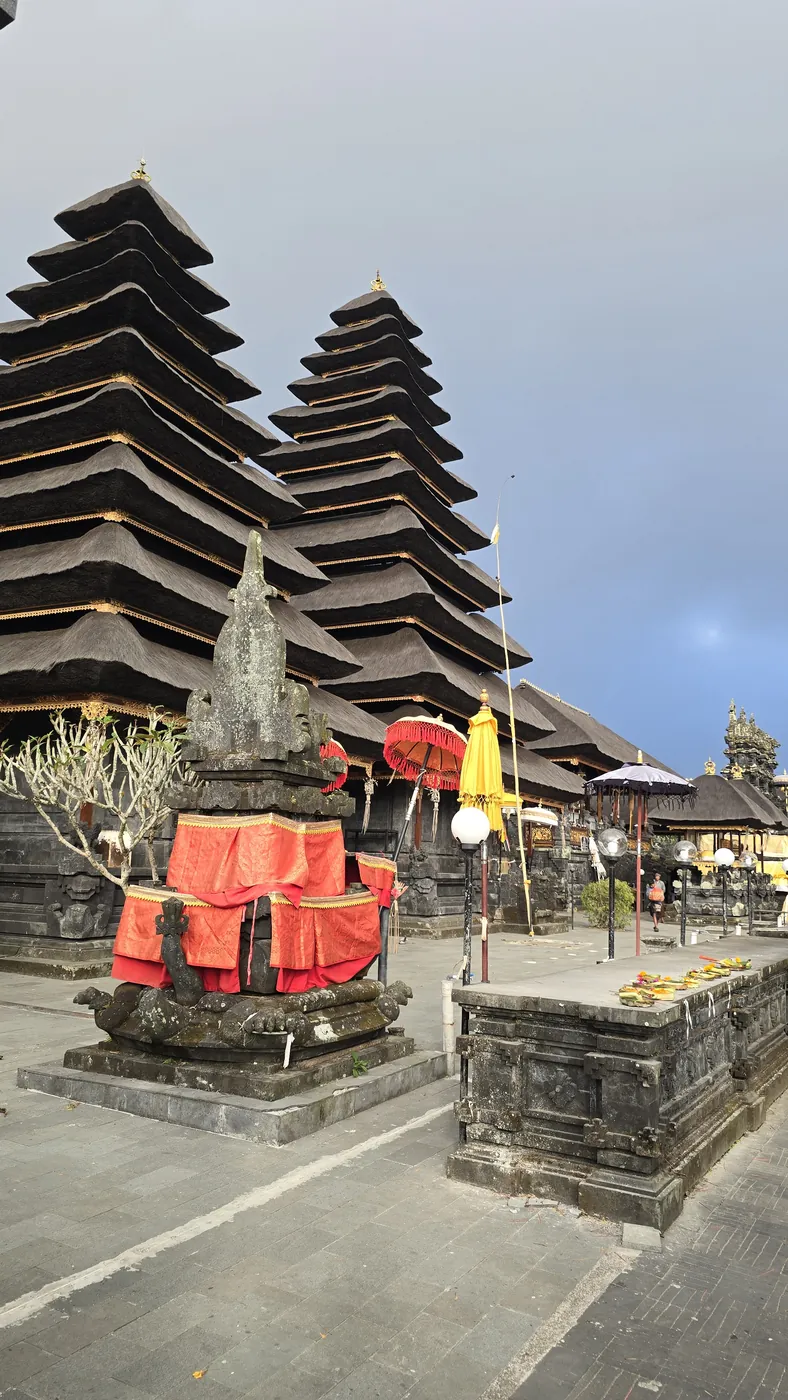
A Balinese temple (pura) is not a building but an open courtyard, or rather a sequence of courtyards that grow holier the further you move from the entrance. You enter through the split gate candi bentar, pass through the outer and middle courtyards into the inner one (jeroan), where the multi-tiered meru shrines with an odd number of roofs (up to eleven) and the padmasana throne stand. The gods do not live here permanently; they come for the temple anniversary (odalan), and for a few days the temple is full of life.
Every traditional village has three temples, the kahyangan tiga, corresponding to the three gods of the Trimurti and three stages of existence:
- Pura Puseh: the temple of origins, dedicated to Vishnu and the founders of the village; it stands on the mountain side,
- Pura Desa (Bale Agung): the temple of the community, dedicated to Brahma; village decisions are taken here,
- Pura Dalem: the temple of death, dedicated to Shiva and the goddess Durga; it stands on the sea side, by the cemetery and the cremation ground.
Above them stand the regional temples and the "mother of all temples", Pura Besakih on the slopes of Mount Agung, a complex of several dozen temples we visited in August 2026.
Offerings: why is canang sari offered every day?
An offering (banten) is the language in which the Balinese speak to the invisible. The simplest is canang sari, a small palm-leaf basket with flowers, rice, a little food and a lit incense stick, placed every morning on doorsteps, in house shrines, beside statues, even on car dashboards. The flowers in several colours correspond to the directions and the gods, and the incense smoke carries the offering upwards. Separate, humbler offerings (segehan) are placed on the ground for the lower spirits, so that they do not interfere. We describe this ritual separately in our article on canang sari.
For the great festivals the offerings grow: women carry gebogan, pyramids of fruit and cakes, on their heads, and in front of every house rises a penjor, a tall, arching bamboo pole decorated with woven palm leaves, ears of rice and fruit. The penjor symbolises Mount Agung and abundance, and a forest of these poles along the streets is the sign that Galungan has come.
Caste, priests and the ceremonies of life
Bali knows four groups (wangsa) modelled on the Indian castes: Brahmins (Brahmana), warriors (Ksatria), merchants (Wesia) and the common people (Sudra), to which roughly nine in ten inhabitants belong. In practice there are none of the rigid prohibitions known from India; today caste mainly affects a person's name, the level of language used to address them and their roles in ceremonies. The names Wayan, Made, Nyoman and Ketut simply mark birth order; Ida Bagus, Anak Agung or Gusti signal higher descent. A high priest (pedanda) comes from a Brahmin family, but a temple priest (pemangku) may come from any group.
A Balinese life is a sequence of ceremonies: rites for the unborn child, the first touching of the ground at three months, birthdays every 210 days, the ritual tooth filing at adolescence (a symbolic blunting of six flaws of character), and marriage. The most important, however, is cremation, ngaben. The body is carried to the cremation ground in a tall tower (bade) and burned in a sarcophagus shaped like an animal, a bull for the higher families. Fire frees the soul, the ashes go to the sea, and the soul may return to the family in a future incarnation. Ngaben is expensive, so villages often hold collective cremations, and the dead are buried temporarily while they wait. It is not a day of mourning but of farewell; grief would make it harder for the soul to leave.
What does this mean for a visitor to Bali?
The Balinese do not expect visitors to know their theology, but a few rules genuinely matter:
- You enter a temple in a sarong with a sash around the waist; most temples lend them at the entrance.
- Tradition does not allow people with an open wound, or women during menstruation, to enter a temple; this is a rule of ritual purity, not a judgement.
- Do not climb on shrines or walls, do not stand higher than the priest and do not walk in front of people praying.
- Step around canang sari on the pavement; treading on one by accident is no sin, but doing so deliberately is a lack of respect.
- On Nyepi stay in your hotel, dim the lights and keep quiet; this applies to everyone on the island.
- The head is the holiest part of the body: do not touch it, not even a child's.
What this means for the objects in your home
On Bali incense smoke is the daily carrier of intention; it is what lifts the canang sari upwards. When we visited the Suputra Natural Incense workshop in August 2026, we saw that herbal incense is made there with the same care as an offering. That is why incense from Bali is not just a scent but part of a rhythm the island has lived by for centuries. You do not have to be Hindu to light a stick in the morning and pause for a moment; it is the simplest form of Tri Hita Karana that can be carried into a European home.
Frequently asked questions
- Is Balinese Hinduism the same as Hinduism in India?
- No. Balinese Hinduism grew out of Indian Hinduism but merged it with ancestor worship, spirits of place and Buddhism. It has one Supreme God (Sang Hyang Widhi Wasa), its own calendars, festivals and forms of offering that do not exist in India.
- What is Nyepi, and does it apply to tourists?
- Nyepi is the Balinese New Year according to the saka calendar, observed as a day of complete silence, usually in March. For 24 hours no fire may be lit and no work, travel or entertainment is allowed; the airport is closed. The rules apply to tourists too, who stay inside their hotels.
- What is Tri Hita Karana?
- Tri Hita Karana is the Balinese philosophy of the "three causes of well-being": harmony with God, with people and with nature. It shapes daily life, the layout of house and village and even the subak irrigation system, inscribed by UNESCO in 2012.
- What are the little flower baskets on the streets of Bali?
- They are canang sari, daily offerings of palm leaf, flowers, rice and incense, placed in the morning for the gods and spirits as thanks and a request for balance. They are set in house shrines, on shop doorsteps and beside statues, and it is polite to step around them.
- Do I need a sarong to enter a temple on Bali?
- Yes. A temple is entered in a sarong with a sash around the waist, regardless of gender. Larger temples lend them at the entrance, but your own sarong is useful in smaller village temples and during ceremonies.
The shop opens in autumn 2026 — the first container is being filled now.
Join the First CircleThe list shops first — 48 h before opening