Guide · Indonesia & Bali
Subak: the Rice Terraces of Bali, Water Temples and the UNESCO Landscape
28 August 2026 · 7 min read
Subak is the traditional Balinese system for irrigating rice fields and, at the same time, the community of farmers who share water from a single source. It has existed since at least the ninth century and combines hydraulic engineering (canals, tunnels, dividers) with religion: every subak has its own water temples, and the order of flooding and planting follows a ritual calendar. In 2012 UNESCO inscribed this landscape on the World Heritage List as the "Cultural Landscape of Bali Province: the Subak System as a Manifestation of the Tri Hita Karana Philosophy".
In this article we explain how subak works, the role of the water temples, what the UNESCO listing protects, how the Jatiluwih terraces differ from Tegallalang, who the rice goddess Dewi Sri is, and what the rice cycle looks like from planting to harvest. We close with the threats to the terraces, how to visit with respect, and why an ear of rice ended up in our logo.
What is subak and how does it work?
Bali is a volcanic island: rain falls on the mountains at its centre, collects in crater lakes and runs down rivers cut into deep gorges. To bring that water to the fields, the Balinese have for more than a thousand years built weirs on the rivers, canals running along the hillsides, tunnels hewn through rock (aungan) and wooden or stone dividers (tembuku) that split the flow into precisely measured shares. Water flows by gravity from terrace to terrace and returns to the river.
A subak is the group of farmers whose fields draw on one intake. Each subak has a head (pekaseh), regular meetings, its own written rules (awig-awig) and penalties for breaking them. Decisions on when to flood the fields and when to plant are taken jointly, so that neighbouring subaks plant in a staggered rhythm: this way there is enough water for everyone and pests never have continuous access to ripe rice. More than a thousand such communities are active on Bali today.
Water temples: Pura Ulun Danu Batur and Pura Taman Ayun
Subak is not merely a farming organisation. On Bali water is a gift of the gods, so its distribution takes a religious form. At every level of the system stands a temple: a small shrine by the divider in the field, a subak temple (pura subak) at the intake, a regional temple at the lake or spring, and finally the highest temples, whose priests are responsible for the water of the whole island.
- Pura Ulun Danu Batur — the temple above Lake Batur in the volcanic caldera, dedicated to the lake goddess Dewi Danu. Its priests traditionally set the irrigation calendar for subaks across a large part of central and southern Bali; it is the most important water temple on the island,
- Pura Taman Ayun — the royal temple of the former kingdom of Mengwi, surrounded by a moat and gardens, with many multi-tiered meru towers. It was built in the seventeenth century as a state temple and at the same time a water temple for the subaks of the kingdom.
Tri Hita Karana in practice
Tri Hita Karana is the Balinese principle of three sources of harmony: between people and the gods (parhyangan), among people (pawongan), and between people and nature (palemahan). Subak is its most literal embodiment. Temples and offerings are the divine dimension, meetings and fair water sharing are the human one, and terraces, canals and farming that does not exhaust the soil are the dimension of nature. That is why UNESCO put the phrase in the title of the listing. We describe the philosophy itself in our article on Balinese Hinduism and Tri Hita Karana.
What exactly does the 2012 UNESCO listing protect?
The World Heritage listing does not cover every rice field on Bali but a selection of areas that together show the whole system, from lake to field:
- 1.The temple Pura Ulun Danu Batur and Lake Batur as the source of water,
- 2.The subak landscape of the Pakerisan river watershed (Gianyar), the oldest known irrigated area, with inscriptions and temples from the first millennium,
- 3.The subak landscape of Catur Angga Batukaru (Tabanan), including the Jatiluwih terraces,
- 4.The royal water temple Pura Taman Ayun (Mengwi).
What is protected is not just a view but a living social system: the communities that have maintained the canals, temples and ceremonies for centuries. Without the farmers the terraces will cease to exist even if the land stays where it is.
Jatiluwih or Tegallalang?
The two most visited places differ more than the photographs suggest. Tegallalang is a fifteen-minute drive from Ubud and is where most visitors end up; Jatiluwih is a broad plateau at the foot of Mount Batukaru, more than an hour further west.
| Jatiluwih | Tegallalang | |
|---|---|---|
| Location | Tabanan regency, roughly 600–700 m above sea level, at the foot of Batukaru | Gianyar regency, fifteen minutes north of Ubud |
| Character | wide, gentle terraces over several hundred hectares, views of the volcanoes | a narrow, steep gorge with terraces on both sides |
| UNESCO status | yes, part of the Catur Angga Batukaru area | no |
| Visitor numbers | moderate, plenty of room to walk | high, with cafés, swings and photo spots |
| Best for | a few hours of walking in quiet | a short stop on the way out of Ubud |
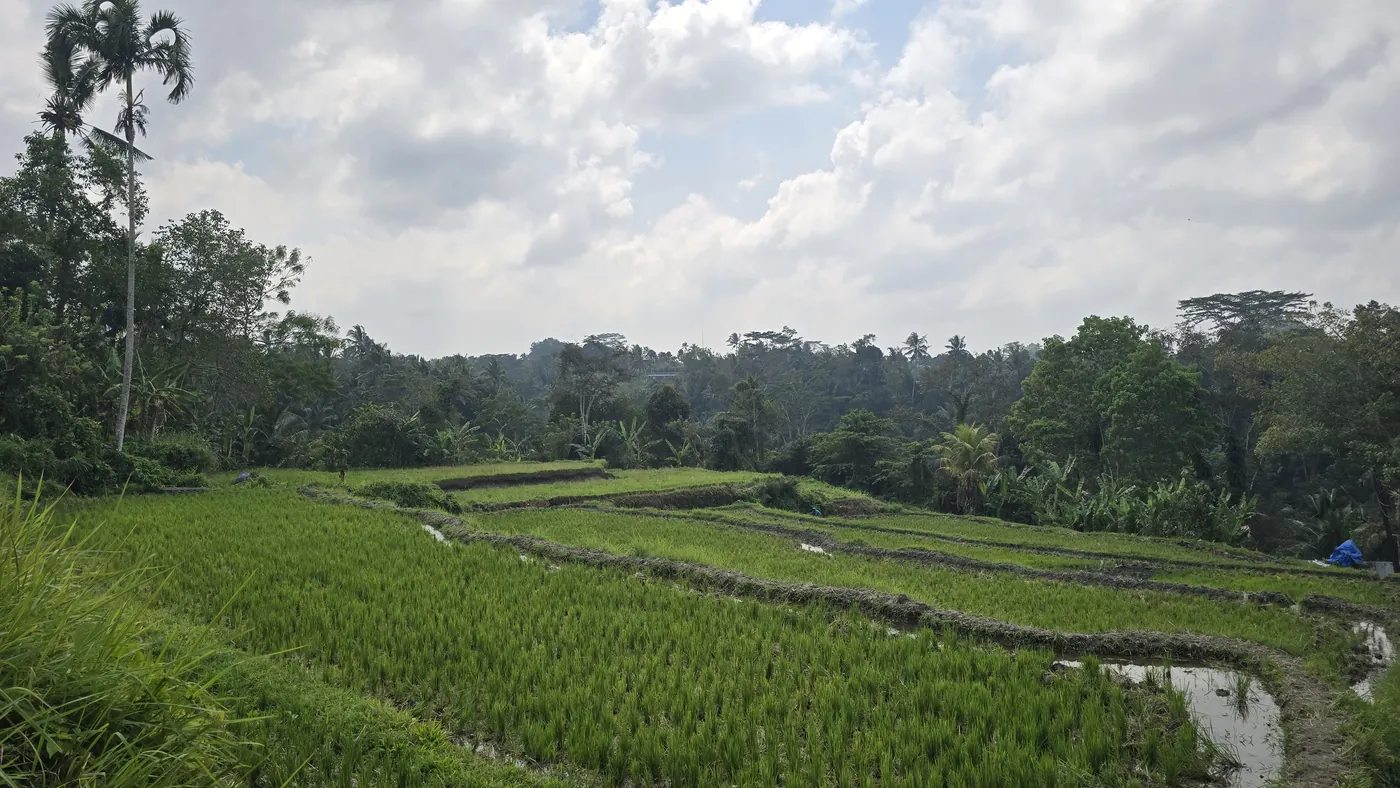
We were in Tegallalang in August 2026, early in the morning, before the cafés opened. Even there, between the swings, farmers were working the fields and water was rushing through the dividers exactly as it did a thousand years ago. If you have a whole day, go to Jatiluwih; if you have an hour, Tegallalang at dawn has its own truth.
Dewi Sri and the rice cycle
Dewi Sri is the goddess of rice, fertility and prosperity, worshipped on Bali and Java. Small shrines dedicated to her stand in the rice fields, and in homes and granaries people hang a cili: a slender figure made of palm leaf with a fan-shaped head, which represents the goddess. In Balinese thinking rice has a soul and ripens like a pregnant woman, hence the offerings made at planting, when it begins to form ears, and after the harvest.
- 1.Water and mud — the field is flooded, ploughed (today more often with a small tractor than a buffalo) and levelled; frogs, dragonflies and ducks return to the water,
- 2.Nursery — the grain sprouts in a dense seedbed in a corner of the field over a few weeks,
- 3.Transplanting — seedlings are set by hand in even rows; it is the most labour-intensive day, and neighbours come to help,
- 4.Green — for the following weeks the fields are intensely green; this is the postcard image,
- 5.Gold — ears heavy with grain bend and turn yellow; strings with fluttering flags hang over the fields to scare off birds,
- 6.Harvest — rice is cut with a sickle, formerly with the small ani-ani knife, threshed on the spot and dried in the sun,
- 7.Rest — the stubble is flooded again or a flock of ducks is let loose on it to eat pests and fertilise the soil.
Traditional Balinese varieties take about half a year to grow, modern ones less, which is why many fields give two and sometimes three harvests a year. At any time of year, then, a flooded field, a green one and a golden one lie side by side.
Rice as food and symbol
On Bali rice is the basis of every meal and the basis of every offering. A few grains pressed to the forehead after prayer signify a blessing, and rice in four colours (white, red, black, yellow) forms part of the offerings to the gods of the four directions. An ear of rice is a sign of abundance, gratitude and the work of hands. That is why the Sari Bali logo carries an ear of rice (padi): two slender stalks and nine golden grains, a sign of what is at once most everyday and most sacred on the island. We write about the other symbols of the island in our article on lotus, frangipani and rice.
What threatens the terraces?
Subak survived colonisation and the green revolution of the 1970s, when imposed varieties and pesticides threw the system out of balance for a few years before the farmers returned to the temple calendar. Today the threat is more prosaic: land is worth more as a villa plot than as a paddy. Every year some terraces in southern Bali disappear under buildings, hotels compete with fields for water, and the young choose work in tourism over work in the mud. The UNESCO listing alone will not protect the landscape if the farmers do not stay in it.
How to visit the rice terraces with respect
- Walk on the dykes, not in the field — the narrow banks between terraces are paths, the seedlings are not,
- Do not block the water — do not move stones or boards in the dividers, not even for a better photo,
- Pay the entrance fee and buy something from the farmers — at Jatiluwih the fee goes to the subak community, and a coffee or coconut bought by the field is real income,
- Arrive early and ask before photographing a person — at dawn it is cool and quiet and people are at work, and a farmer in a hat is not part of the scenery.
What this means for the objects in your home
The culture of rice is visible at every step in a Balinese home: in bowls of wood and coconut shell, in bamboo rice baskets, in wooden ladles and the trays on which grain is dried. In our kitchen and table category we gather exactly such things: simple, handmade from natural materials, from the same island where water is still shared according to the temple calendar. And if you want to see how rice travels from field to altar, read about canang sari, the morning ritual of Bali.
Frequently asked questions
- What is subak on Bali?
- Subak is the traditional system of irrigating rice fields and at the same time the community of farmers sharing one water intake. It has its own temples, a head and written rules, and water is allocated according to the ceremonial calendar. The system has existed since at least the ninth century.
- Why are the rice terraces of Bali a UNESCO site?
- In 2012 UNESCO inscribed the "Cultural Landscape of Bali Province" as an example of the subak system, a living combination of hydraulic engineering, community and religion based on the Tri Hita Karana philosophy. The listing includes Pura Ulun Danu Batur, the Pakerisan watershed, the Jatiluwih terraces and Pura Taman Ayun.
- Jatiluwih or Tegallalang: which terraces should I choose?
- Jatiluwih is a vast, quiet UNESCO-listed landscape more than an hour from Ubud, ideal for a walk of several hours. Tegallalang is fifteen minutes from Ubud, steep, very photogenic and crowded. With a full day, choose Jatiluwih; with an hour, Tegallalang at dawn.
- Who is Dewi Sri?
- Dewi Sri is the goddess of rice, fertility and prosperity worshipped on Bali and Java. Shrines to her stand in the fields, and homes hang a cili, a palm-leaf figure representing her. Offerings are made to her at planting, when the rice forms ears, and after the harvest.
- How many times a year is rice harvested on Bali?
- Usually twice, and on some fields with high-yield varieties three times. Traditional Balinese varieties take about half a year to grow, modern ones less. That is why flooded, green and golden fields can be seen side by side all year round.
The shop opens in autumn 2026 — the first container is being filled now.
Join the First CircleThe list shops first — 48 h before opening