Guide · Craft & interiors
Woodcarving from Mas — the Village That Taught Bali to Carve
3 September 2026 · 6 min read
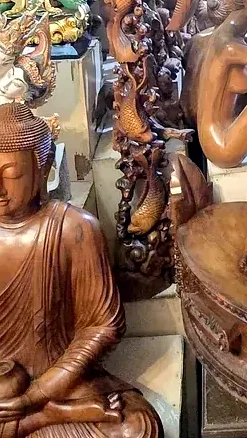
Mas means "gold". Yet this small village just south of Ubud mines no ore — for generations its gold has been wood, and what local hands can draw out of it. Since the 1930s, Mas has been the heart of Balinese carving, the point where the island's craft crossed over into art.
A village where nearly every house carves
In Mas, carving is not a profession for the chosen few — it is the fabric of the village. Nearly every household is tied to the craft, and the skill passes from father to son. International fame came in the 1920s and 30s, when European artists — Walter Spies and Rudolf Bonnet — settled here and championed the local makers, sparking the movement that carried Balinese art out into the world.
Ida Bagus Tilem — the master who carved emotion
Mas was home to one of the greatest Balinese sculptors — Ida Bagus Tilem (1936–1993), son of the equally revered Ida Bagus Nyana. Tilem entered history as the first who, instead of fighting naturally twisted, misshapen wood, used its form to express human emotion in abstract shapes. At his peak he had more than a hundred students, and his sculpture represented Indonesia at the New York World's Fair in 1964.
It is an important lesson about craft: the master does not impose form on the wood, but listens to what the wood wants to become. The Balinese consider that sensitivity part of taksu — the spiritual energy a maker leaves in the work.
The wood matters
Not every wood suits every carving. The carvers of Mas reach for different species depending on what they are making:
- Nangka (jackfruit) — considered by the Balinese the finest wood for carving; it has a warm, golden tone and traditionally serves for religious figures.
- Suar (rain tree) — dark, with interlocked fibres that resist cracking; it is used for larger forms and statues.
- Waru (hibiscus) — white with pale grey, yielding distinctive two-tone carvings.
- Albesia — soft and white, most often used for smaller pieces.
Before a carver reaches for the chisel, he usually begins with an offering and a prayer to Dewi Saraswati, goddess of knowledge and the arts. Because in the Balinese understanding, the work begins not with the first cut, but with the intention.
Frequently asked questions
- What wood are Balinese carvings made from?
- Most often nangka (jackfruit, prized for religious figures), suar (rain tree, for larger forms), hibiscus (two-tone carvings) and soft albesia. The choice of wood depends on what is being made.
- Who was Ida Bagus Tilem?
- One of the greatest Balinese sculptors (1936–1993), from the village of Mas. He was the first to use naturally misshapen wood to express emotion in abstract form. He represented Indonesia at the New York World's Fair in 1964.
- Why is the village of Mas famous for carving?
- Since the 1930s it has been the centre of Balinese woodcarving — nearly every household carves, and the tradition passes from generation to generation. The support of European artists in the 1920s and 30s brought the village international fame.
The shop opens in autumn 2026 — the first container is being filled now.
Join the First CircleThe list shops first — 48 h before opening