Guide · Indonesia & Bali
Kamasan Painting: the Classical Wayang Style of Klungkung
30 August 2026 · 7 min read
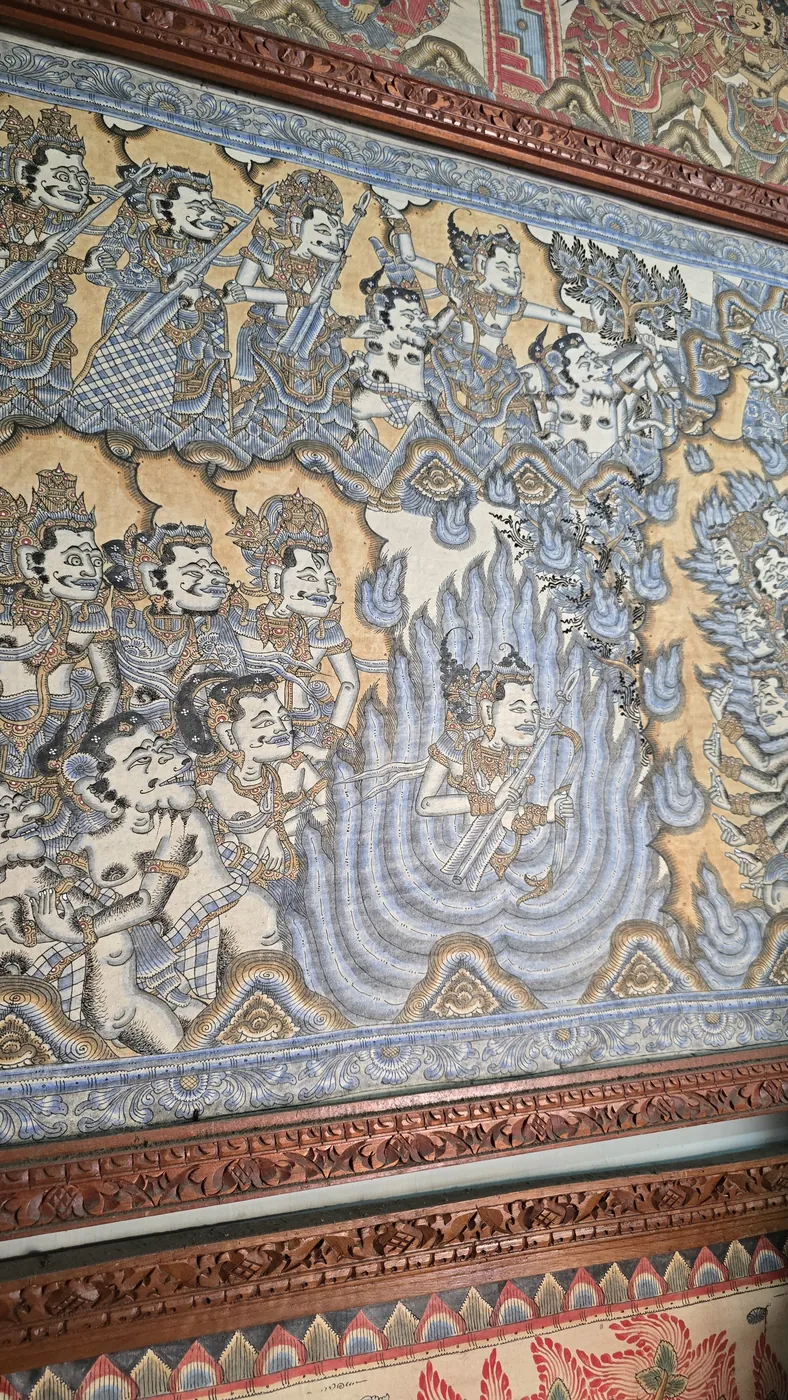
Kamasan painting is the classical style of Balinese painting, also called the wayang style because its figures resemble the flat puppets of the Javanese-Balinese shadow theatre. It developed at the courts of the kings of Gelgel and Klungkung in the sixteenth and seventeenth centuries, depicts scenes from the Hindu epics, and is still produced almost exclusively in a single village: Kamasan, in Klungkung regency in eastern Bali. The most famous set of such paintings covers the ceiling of Kerta Gosa, the former court pavilion in Klungkung.
In this article we describe how to recognise the wayang style, which stories the paintings tell, what the pigments are made of and what they are painted on, how work is organised in a workshop where the master draws and the apprentices colour, what Kerta Gosa is, and how the painters' village lives today. At the end we explain how to tell an original from a print and how to hang a painting at home. In August 2026 we visited the studio of the painter I Nyoman Kondra in Kamasan.
How do you recognise the wayang style?
A Kamasan painting reads like a page of a story, not like a window onto the world. There is no perspective and no shadow: figures stand on a single plane, turned three-quarters to the viewer, with elongated eyes, a clear profile of the nose and hands arranged in gestures known from dance. A character is identified by fixed signs: crown, skin colour, shape of the eyes and costume. Gods and noble princes have slender, calm faces; demons and giants have bulging eyes, fangs and coarse features.
The background is filled with ornament: rock formations, flowering trees, wavy clouds and decorative "wings" that lead into the next scene and separate the episodes. The composition is often continuous, like a comic strip without frames, and the order of reading is set by the gestures of the figures. It is a visual language with centuries behind it and very few changes, which is exactly why it is so easy to recognise.
Which stories do Kamasan paintings tell?
The repertoire is essentially the same as in shadow theatre, dance and the recitation of poetry on Bali:
- Ramayana — the story of Rama, the abduction of Sita, the monkey warrior Hanuman and the war against Ravana; the most frequent subject,
- Mahabharata — the Pandava and Kaurava brothers, the great battle and above all the Bhima Swarga episode: Bhima's journey to the underworld to rescue the souls of his parents, with scenes of infernal punishment and heavenly reward,
- Sutasoma — an Old Javanese poem about a bodhisattva prince, the source of Indonesia's motto "Bhinneka Tunggal Ika" (unity in diversity),
- Tantri — animal fables about wisdom and cunning, the counterpart of the Panchatantra,
- calendars and astrology — palelintangan charts linking the days of the Balinese week with signs, fate and character.
The paintings originally had a religious and didactic function: they were hung in temples and pavilions during ceremonies as ider-ider (long, narrow strips under the eaves), langse (curtains) and tabing (rectangular panels). Only in the twentieth century, with the arrival of foreigners, did paintings appear that were made to hang on the wall of a house.
What are the pigments made of, and what is painted on?
The traditional Kamasan palette is narrow and earthy, which sets it apart from the colourful painting schools around Ubud. The support is cotton cloth, formerly also bark cloth (daluang), primed with rice paste and burnished with a shell. Before factory paints arrived, the colours came from whatever was at hand:
| Colour | Traditional source | Used for |
|---|---|---|
| yellow and reddish | ochres, natural clays from the earth | skin of gods and nobles, ornaments, backgrounds |
| black | soot from an oil lamp | outlines, hair, demons |
| white | powdered bone or lime from shells | priming, highlights, eyes |
| brown, red | earth, in some workshops also resins | costume, rocks, contrast |
| blue (rare) | indigo | occasional costume details |
The binder was animal or plant glue. Today most painters use ready-made acrylics, usually chosen to stay close to the old tonality; some workshops, including those that supply paintings to temples, still grind their own pigments. Natural colours are matt and acquire a warm, muted tone over time that acrylic cannot reproduce.
How a workshop works: the master draws, the family colours
A Kamasan painting is rarely the work of one person. The traditional division of labour runs like this:
- 1.Sketch — the master (sangging) draws the composition in pencil or with a fine brush; he decides the arrangement of scenes and the character of the figures,
- 2.Colouring — apprentices, often the wife, children and neighbours, fill the areas with colour according to a fixed colour code,
- 3.Shading and ornament — others add the patterns on costumes, gradations and backgrounds,
- 4.Outline — the master returns to the painting and lays down the final thin line in ink or black, which brings the figures to life; this stage decides the quality of the whole.
Signatures appeared only in the twentieth century; old paintings are anonymous, because the author was the workshop and the tradition, not a person. In this sense Kamasan painting resembles the other Balinese crafts we wrote about in our piece on taksu, the soul that sets handicraft apart: what counts is not the signature but whether the painting is "correct" and alive.
Kerta Gosa: the ceiling that passed judgement
Kerta Gosa is an open pavilion in the complex of the former royal palace in Semarapura (Klungkung), built in the early eighteenth century as the place where the king and priests decided the gravest legal cases. Its entire ceiling is covered with Kamasan paintings arranged in tiers: Tantri fables at the bottom, above them Bhima Swarga with detailed scenes of punishment in the afterlife (boiling in cauldrons, sawing, fire) and rewards for the just, and heavenly scenes at the top. The accused sat beneath this ceiling and knew what awaited him.
Most of the palace was destroyed in 1908 during the puputan of Klungkung, the last battle against the Dutch, which we describe in the history of Bali from Majapahit to today. Kerta Gosa and the neighbouring Bale Kambang (a floating pavilion in a pond, with paintings of Sutasoma and other tales) survived. The paintings were renewed several times in the twentieth century, always by painters from Kamasan, so what you see today is largely the work of recent generations rather than the eighteenth century, and that is exactly how this tradition works.
Kamasan today: the painters village
Kamasan lies a few minutes from Semarapura. From outside it looks like any other Balinese village: brick walls, gates to family compounds, temples. Behind the gates, however, work families who have painted for generations, alongside smiths who make ceremonial coins and vessels here. Painting is not a museum piece: temples, clans and collectors still commission works, and many painters teach their children and grandchildren. In August 2026 we visited the studio of I Nyoman Kondra, where several people were working on one stretched canvas at once: one drawing the outline, others filling in colour. That is what a workshop looks like that has not changed since the days of Gelgel.
The largest collections of old paintings can be seen in the Semarajaya Museum next to Kerta Gosa and in museums on Bali and in Europe; many of the oldest works entered Dutch collections in colonial times. Kamasan is one of the stops on our map of the craft villages of Bali.
How to recognise an original
- The line — in an original the outline is drawn by hand: thicker here, thinner there, with small hesitations; in a print it is perfectly even and identical on every copy,
- Texture — on cloth you can see the weave and a slight unevenness of the priming; the paint sits in a layer you can feel under a finger,
- The back — an original has raw cloth with colours showing through; a print has a uniform white or thin backing,
- Colour — traditional pigments are matt and muted; saturated, glossy colours mean acrylic or print,
- Price and time — a painting that several people worked on for weeks cannot cost the same as a poster.
The general rules for telling an original from a mass-produced item are collected in our article on Balinese handicraft and how to spot a fake.
What this means for the objects in your home
A Kamasan painting is the best proof that Balinese wall decoration need not be a souvenir: it is a picture with its own alphabet and a history older than most European museums. At home it looks best on its own, on a calm wall, in a simple wooden frame or stretched on a frame without glass, away from direct sun and the humid bathroom. Natural pigments fade under UV, so the wall opposite a window is a poor choice, while a wall deeper in the room, lit with warm light, is a very good one. You will find paintings and other handmade pieces for the wall in our wall decor category; raw textiles and carving sit well beside them, as we describe in our article on Balinese style in the interior.
Frequently asked questions
- What is Kamasan painting?
- It is the classical style of Balinese painting, known as the wayang style, in which figures resemble shadow-theatre puppets: flat, without perspective, with fixed signs of identity. It developed at the courts of Gelgel and Klungkung in the sixteenth and seventeenth centuries and survives today in the village of Kamasan.
- What do wayang-style paintings depict?
- Scenes from the Ramayana and Mahabharata (especially Bhima's journey to the underworld), the poem Sutasoma, the Tantri animal fables and Balinese astrological calendars. They used to be hung in temples during ceremonies and today also in homes.
- What are the pigments in Kamasan painting made of?
- Traditionally from ochres (yellow and red), soot (black), powdered bone or shell lime (white) and rarely indigo, bound with glue. Today many painters use acrylics in the old tonality, while some still grind their own pigments.
- What is Kerta Gosa in Klungkung?
- It is the court pavilion of the former royal palace in Semarapura, from the early eighteenth century, whose ceiling is covered with Kamasan paintings of punishment and reward in the afterlife. It survived the puputan of 1908 and has been renewed several times by painters from Kamasan.
- How can I tell an original Kamasan painting from a print?
- By the hand-drawn, uneven outline, the texture of the cloth and paint layer, the raw back with colour showing through, and the matt, muted colours. A perfectly even line, glossy colours and a very low price point to a print.
The shop opens in autumn 2026 — the first container is being filled now.
Join the First CircleThe list shops first — 48 h before opening