Guide · Materials
Indonesian Wood: Suar, Teak, Mahogany and Other Species Compared
21 August 2026 · 8 min read
Indonesian wood, as far as furniture, table tops and carvings sold in Europe are concerned, means a handful of species: suar (rain tree), teak, mahogany, jackfruit (nangka), the light pule and albesia, and the dark sonokeling, or Indian rosewood. They differ in weight, colour, resistance to moisture and in how they cope with the dry air of European homes, which is why a dining table, a bathroom counter and a carving each call for a different wood.
In this article we describe each species and set them side by side in one table. We explain why tropical wood cracks in a European flat in winter and how to prevent it, how to oil it, what the abbreviations SVLK and EUDR mean, and how to tell solid wood from veneer in a shop.
Which species go into Indonesian furniture and carvings?
Craft and furniture today rely mainly on plantation and roadside species rather than primary forest. These are the ones you will meet most often.
Suar, the rain tree (Samanea saman)
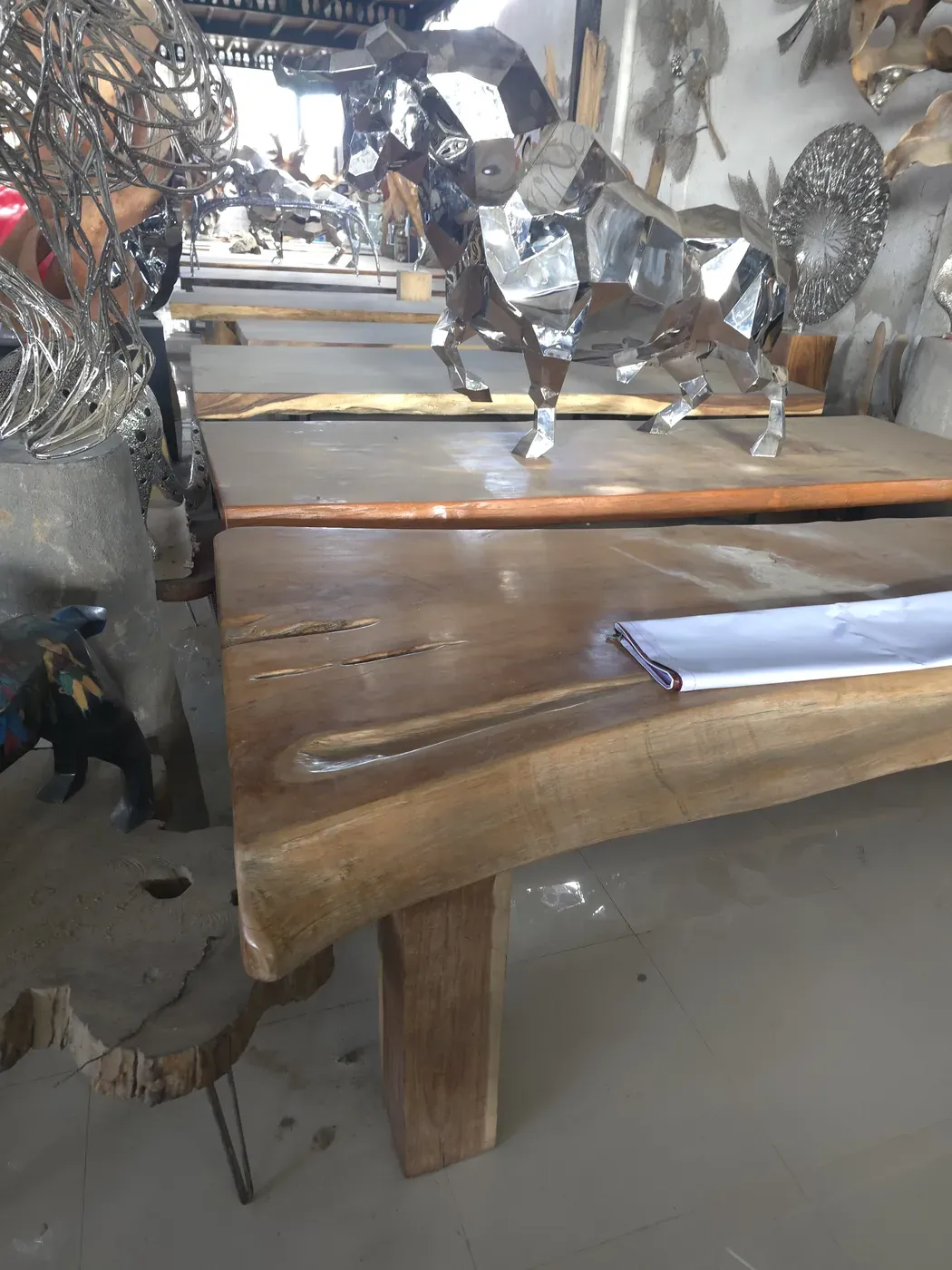
Suar, called trembesi in Indonesian, is a fast-growing shade tree planted along roads and in pastures. It has a thick trunk, so a single tree yields slabs more than a metre wide, which is why live edge tops (with the natural edge left on) are so often made of it. The wood is strikingly two-toned: creamy sapwood and golden-brown to chocolate heartwood, often with darker streaks. It is moderately hard, has open pores and likes to move, as we explain below.
Teak (Tectona grandis)
Teak is the best-known timber of Southeast Asia. It contains natural oils and silica, which make it resistant to water, fungi and insects: the wood of ship decks and garden furniture. Freshly cut it is golden honey, it darkens to brown with time, and left in sun and rain without oil it turns silver-grey. On Java, teak grows on plantations managed by the state forestry company Perhutani, and the centre of its working for centuries has been Jepara.
Mahogany (Swietenia)
Mahogany in Indonesia is a plantation species, brought to Java in colonial times. It has a straight grain, a reddish-brown colour that deepens with age and good dimensional stability, which is why cabinet makers like it for cupboards, frames and turned parts. It is less moisture-resistant than teak, so it is a wood for indoors.
Jackfruit, nangka (Artocarpus heterophyllus)
The wood of the jackfruit tree, nangka in Indonesian, is almost canary yellow when cut and darkens over time to a warm orange-brown. On Bali and Java it is the traditional wood for gamelan instruments, temple figures and carvings. It is moderately hard, fine-grained and holds detail well, which is why the carvers of Mas reach for it so readily.
Pule and albesia: wood for masks and figurines
Pule (Alstonia scholaris) is a light, pale, soft wood from which Balinese carvers traditionally make dance and sacred masks; a mask has to be light because the dancer wears it for a whole performance. Albesia (sengon, Falcataria) is an even lighter, fast-growing plantation wood for painted figurines and ornaments. Both dent easily and cannot take rain; they are woods for decoration, not for a table top.
Sonokeling, Indian rosewood (Dalbergia latifolia)
Sonokeling is a heavy, very hard wood ranging from purplish brown to nearly black, with pronounced dark veining. It grows on plantations in Java and is prized for small objects, inlay and instruments. A caution: all species of the genus Dalbergia are listed under CITES (Appendix II), so their export needs additional permits. This is not a ban, but an object made of sonokeling should come with documented origin.
Species compared: hardness, colour, use, care
| Species | Hardness / weight | Colour | Use | Care |
|---|---|---|---|---|
| Suar (rain tree) | moderately hard, approx. 550–650 kg/m³ | creamy sapwood and golden-brown heartwood | live edge tops, tables, benches, bowls | oil or hardwax oil once or twice a year; air humidity 45–55% |
| Teak | hard, approx. 650 kg/m³, naturally oily | honey, darkens to brown, silvers in sun | furniture, bathroom, garden, boats | teak oil; outdoors it may be left to weather |
| Mahogany | moderately hard, approx. 550–650 kg/m³ | reddish brown, darker with age | cupboards, frames, indoor furniture | oil or wax; indoors only |
| Jackfruit (nangka) | moderately hard, approx. 600 kg/m³ | yellow, turning orange-brown | carvings, figures, instruments | oil or wax; keep out of full sun |
| Pule / albesia | soft and light, approx. 300–450 kg/m³ | pale, creamy | masks, painted figurines, decor | dusting only; do not oil painted pieces |
| Sonokeling (rosewood) | very hard, approx. 800 kg/m³ and more | purplish brown to black | small objects, inlay, instruments | oil; requires CITES paperwork |
Why does tropical wood crack in a European flat in winter?
Wood is hygroscopic: it gives off and takes up moisture from the air, and as it does so it shrinks and swells, most of all across the grain. On Bali the air sits at around 70–85 percent relative humidity all year round, and wood settles there at a moisture content in the low to mid teens. In a Central European flat during the heating season humidity drops to 20–30 percent and wood heads towards 6–8 percent. Across a wide suar slab that means several millimetres of shrinkage, and that is where cracks, warping and gaps in glued panels come from.
A good maker kiln-dries the wood and fixes table tops so they can move, but even the best-dried solid wood will respond to dry air. What you can do:
- Keep humidity at 45–55 percent. In winter that usually means a humidifier; a cheap hygrometer tells you at once whether there is a problem.
- Keep your distance from heat. A metre from radiators and fireplaces; over underfloor heating give the piece feet or a mat.
- Avoid direct sunlight. It heats and dries one side of a top, and UV changes the colour.
- Allow time to acclimatise. Place the piece where it will live and wait a few weeks before loading it.
- Do not panic over hairline cracks. In suar and teak they are normal and often close again in summer. Do not fill them with putty straight away.
How do you oil and care for tropical wood?
Oil does not seal wood the way lacquer does; it penetrates the pores, slows the exchange of moisture and brings out the grain. Hardening oils (linseed, tung, ready-made hardwax oils) suit suar, teak and mahogany; teak, thanks to its own oils, needs the least. The general rhythm: wood in heavy use, such as a dining table or a bathroom counter, twice a year; carvings and decor once every year or two. Apply thinly, rub in along the grain and wipe off the excess after 15–20 minutes, because what is left turns into a sticky layer that catches dust. You will find a full walkthrough in our guide to oiling teak furniture step by step.
For everyday care a damp, well-wrung cloth and mild soap are enough. Avoid silicone sprays, ammonia and vinegar. Water marks on an oiled top usually disappear after a light sanding with fine paper and re-oiling, which is the great advantage of oil over lacquer.
Is Indonesian wood legal? SVLK and EUDR
Indonesia has a mandatory timber legality verification system, SVLK (Sistem Verifikasi Legalitas Kayu), and since 2016 it has been the first country in the world to issue FLEGT licences recognised by the European Union; every legal shipment of furniture from Indonesia to the EU carries such a document. In parallel, the EU is introducing the EUDR regulation, which requires importers to prove that wood does not come from deforested land, meaning the place of harvest must be identified even for plantation timber. We explain both systems in our article on SVLK and EUDR timber certificates. The short version: ask the seller for the paperwork; a serious importer has it to hand.
How do you tell solid wood from veneer?
Veneer is a thin sheet of real wood glued onto a board or a cheaper timber. It is an honest cabinet-making technique, but it should be called by its name and priced accordingly. How to check:
- 1.Look at the edge of the top. In solid wood the grain on the surface continues onto the side and end of the board; in veneer the pattern stops at the edge and the end shows board or a thin line of edging.
- 2.Look for repeats. Veneer is sliced from one log and laid out in mirrored, identical patterns; nature does not repeat itself.
- 3.Turn the piece over. The underside of solid wood looks like the top, only less finished; with veneer it is often a different material altogether.
- 4.Weigh and tap it. Solid wood is heavy and sounds dull; board sounds hollow.
- 5.Knots, pith marks and a natural edge with traces of bark are an almost certain sign of solid wood.
What this means for the objects in your home
Walking through the workshops of Mas in August 2026, we remember craftsmen judging by the weight and sound of a board whether it was dry enough to carve. That is where a good object begins, and after that there is only care. We list our solid wood furniture and carvings with the species named, because choosing between suar, teak and nangka is choosing between the character of a top, resistance to water and a colour that will change with you over the years. Everything begins with curiosity.
Frequently asked questions
- Is suar wood good for a dining table?
- Yes, suar is one of the most popular choices for live edge dining tables: it is moderately hard, comes in wide two-toned slabs and polishes well. It does need stable air humidity (45–55 percent) and oiling once or twice a year, because in a dry flat it moves more than teak.
- Which Indonesian wood is the most water-resistant?
- Teak. Its natural oils and silica protect it against water, fungi and insects, which is why it has been used for boats, garden furniture and bathrooms for centuries. Mahogany and suar are indoor woods, and pule and albesia are not suited to damp places at all.
- Why did my tropical wood table top crack in winter, and is it a defect?
- Most often it is the result of dry air during the heating season: the wood gives off moisture, shrinks across the grain and cracks along it. Hairline cracks in solid wood are not a manufacturing defect and often close again in summer. A humidifier, distance from radiators and regular oiling prevent them.
- How often should tropical wood furniture be oiled?
- Pieces in heavy use, such as a dining table or a bathroom counter, twice a year; carvings and decor once every year or two. The signal is dull, thirsty-looking wood on which water no longer beads. Apply thinly and always wipe off the excess.
- Is Indonesian teak legal and sustainable?
- Javanese teak comes mostly from plantations of the state company Perhutani, and Indonesia is the only country issuing FLEGT licences recognised in the EU under its SVLK system. Legal imports carry documents worth asking the seller about. Plantation timber is a renewable resource as long as its origin is documented.
The shop opens in autumn 2026 — the first container is being filled now.
Join the First CircleThe list shops first — 48 h before opening