Guide · Materials
Stone from Bali and Java: River Stone, Onyx, Paras and Terrazzo in the Bathroom
23 August 2026 · 8 min read
Stone from Bali and Java, as it reaches European bathrooms and gardens, means chiefly five materials: dark river boulders (andesite and basalt from river beds), translucent onyx, soft volcanic paras, cream-coloured palimanan sandstone and terrazzo. They differ in hardness, porosity and resistance to acids and frost, which is why some make a good sink, others a garden sculpture, and others belong strictly indoors.
In this article we describe each stone and compare them in a table. We show how a sink is carved from a river boulder, what to watch for during installation (weight, drain, silicone), how to seal and clean stone without acids, what to do about stains and which stone will survive a Central European winter. At the end we take you to Batubulan, the stone carvers' village we visited in August 2026.
Which stones come from Bali and Java?
River stone: andesite and basalt
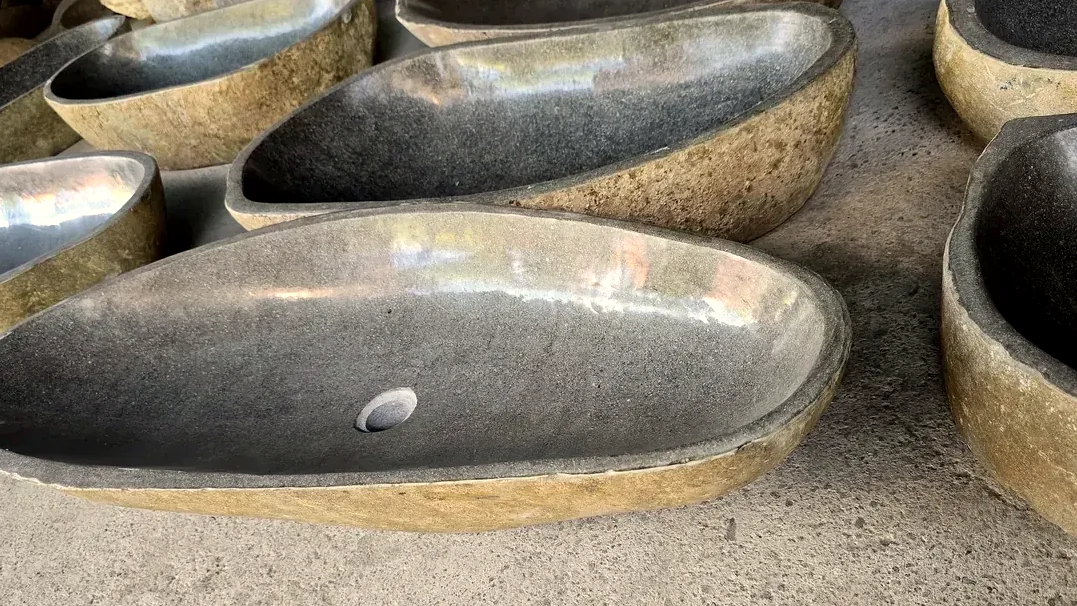
The rivers running down from the volcanoes of Bali and Java carry boulders of andesite and basalt, volcanic rocks that water has polished over thousands of years into smooth, rounded forms. They are dark grey to almost black, hard, dense and absorb little water. River stone sinks are made from exactly these: the carver chooses a boulder of the right shape and hollows a basin into it, leaving the raw natural surface on the outside. The same dark andesite (batu candi, temple stone) built Borobudur and still clads walls and paths in Balinese gardens.
Onyx, or rather onyx marble
What the trade calls Bali or Java onyx is not onyx in the mineralogical sense (a variety of chalcedony) but banded, translucent calcite: onyx marble, a relative of travertine. It is quarried mainly on Java. Its colours run from milky white through honey and amber to green, with wavy veins, and it lets light through: a sink or lamp of onyx lit from below glows like a lantern. The price of that beauty is softness (around 3 on the Mohs scale) and sensitivity to acids; a drop of lemon leaves a dull mark.
Paras: soft volcanic tuff
Paras (batu paras) is a pale, greyish or yellowish volcanic tuff, compacted ash that can be sawn and chiselled almost like wood. It is the stone of Balinese temples and gateways: reliefs, guardians and ornaments are cut from it. It is very porous, soaks up water and in a humid climate grows moss within months, which on Bali counts as a virtue, since the temple matures. In Europe that same porosity means paras cannot take frost.
Palimanan sandstone
Palimanan is a cream-coloured, warm-toned sandstone from the Cirebon area of West Java. It is harder and less absorbent than paras, has a fine, even grain and takes both a smooth finish and carved relief well. It is used for wall cladding, slabs, bowls and figures for interiors and sheltered terraces.
Terrazzo
Terrazzo is not a natural stone but a composite: chips of marble or other stone set in a cement binder, ground and polished once cured. In Indonesia it is cast into sinks, bathtubs, planters and counters in any colour of binder. The surface is smooth and uniform, but cement and marble are both acid-sensitive, so terrazzo needs sealing just as onyx does.
Stones compared: origin, hardness, use, care
| Stone | Origin | Hardness / porosity | Used for | Care |
|---|---|---|---|---|
| River stone (andesite, basalt) | river beds of Bali and Java | hard (approx. 6 Mohs), low absorption | sinks, bowls, pebble mats, garden | sealer once a year; mild cleaners; frost-proof |
| Onyx (onyx marble) | Java | soft (approx. 3 Mohs), moderately porous | sinks, lamps, backlit counters | sealer once or twice a year; no acids; indoors only |
| Paras (volcanic tuff) | Bali, Java | very soft, very porous | sculptures, reliefs, wall cladding | sealer; not outdoors in a climate with frost |
| Palimanan sandstone | Cirebon, West Java | moderately hard, moderately porous | cladding, bowls, figures | sealer; sheltered terraces, no standing water |
| Terrazzo | composite, cast in Indonesia | moderately hard, cement absorbs water | sinks, bathtubs, planters, counters | sealer; no acids; planters indoors only |
How is a river stone sink made, and how do you install it?
A sink from a river boulder is one of the few objects nobody manufactures; the carver reveals what the river has already done. The work goes like this:
- 1.Choosing the boulder. The carver looks for a piece with a flat, stable base and enough height, and taps it with a hammer; a clear ring means no hidden cracks.
- 2.Base and hole. The bottom is cut flat with a diamond saw and a drain hole is drilled for a standard pop-up waste (usually around 45 mm).
- 3.Hollowing the basin. The inside is cut with a diamond grinder and deepened with a chisel, layer by layer, until a basin with an even wall thickness emerges.
- 4.Grinding and polishing. The interior is wet-ground with ever finer pads until smooth to the touch; the outside stays raw.
- 5.Sealing. The finished sink is saturated with a stone sealer that closes the pores and makes cleaning easier.
Installation: weight, drain, silicone
- Weight. A river stone sink weighs from around fifteen to several tens of kilograms. The cabinet or counter must carry it; best is a solid wood or stone counter on a sturdy frame. We write about pairing stone with wood in our piece on teak furniture for the bathroom.
- Drain. The hole is drilled for a universal waste, but the sink wall can be thick; check that the waste thread is long enough before ordering the tap and trap.
- Silicone. Use only neutral-cure silicone (not acetic) for sealing; acetic silicone can discolour the stone around the joint.
- Level. Every sink base is different, so dry-fit and level it before drilling the counter; a minimal fall towards the drain is enough.
How do you seal and care for stone in the bathroom?
Natural stone is porous, so the first and most important step is sealing: an impregnating sealer (usually silane- or siloxane-based and vapour-permeable) penetrates the pores so that water and grease stay on the surface instead of soaking in. Repeat once a year; the test is simple: if a drop of water darkens the stone after a few minutes instead of beading, it is time for another coat. Stone oil can be used instead of a sealer and additionally deepens the colour of dark river stone.
Day to day, a soft cloth, warm water and a pH-neutral cleaner are enough. Wipe the sink dry after each use; it is the only effective prevention against limescale. What to avoid:
- Acids. Vinegar, citric acid, descalers and most bathroom cleaners etch onyx, terrazzo and paras within seconds; on andesite they are less dangerous but destroy the sealer.
- Abrasives and scouring pads. They scratch the polished interior of the basin.
- Bleach. It can discolour the terrazzo binder and dark river stone.
- Standing water. In a terrazzo planter or a paras bowl it leads to efflorescence and stains.
Stains and deposits
Hard-water deposits on river stone come off with a sponge and a very dilute neutral cleaner, and in stubborn cases with a gentle rub of fine wet sandpaper followed by resealing. A grease or cosmetics stain is drawn out with a poultice: a paste of baking soda and water left on for a few hours under cling film. On onyx and terrazzo never try to remove deposits with acid; the dull etched mark can only be removed by repolishing at a stonemason's.
Frost: which stone can stand outdoors in Central Europe?
Water in the pores of stone expands as it freezes and bursts the stone from within. That is why only dense, low-absorption andesite and basalt belong on a terrace or in a garden with real winters: river stone, pebble mats, bowls. Paras, terrazzo and onyx stay indoors or are stored away for winter; palimanan sandstone survives under a roof but not where water stands. Paras sculptures, so common in Balinese gardens, should be placed indoors, on a sheltered veranda or in an unheated but dry conservatory.
Batubulan, the village that carves stone
Batubulan lies on the road from Denpasar to Ubud, in Gianyar regency, and has been a village of stone carvers for generations: along the main street stand rows of guardians, deities and fountains in paras and andesite, and behind them open workshops where you hear the tapping of chisels. In August 2026 we visited the Yuliani Stone Carving workshop. We remember how differently paras and river stone are worked: the first is carved quickly but carefully because it crumbles like chalk; the second needs diamond tools and patience but will outlast the house it stands in. Batubulan is one of the stops on our map of craft villages.
What this means for the objects in your home
A stone sink or bowl is the most literal piece of the island you can put in a flat: it was not manufactured but chosen from a river and revealed. In our bathroom collection we state which stone each object is made of, what it weighs and whether it has been sealed, and we label our sculptures and figures so you know which can stand outdoors. The rest is a few minutes a year with a sealer and a dry cloth after each use. Every object has a face; a river stone has had one for thousands of years.
Frequently asked questions
- Is a river stone sink practical for everyday use?
- Yes, provided it is sealed once a year and wiped dry after use. Andesite and basalt are hard, absorb little water and are not bothered by hot water. The main enemies are hard-water deposits and acidic cleaners, which destroy the sealer.
- How much does a river stone sink weigh, and will my cabinet hold it?
- Depending on size, from around fifteen to several tens of kilograms; large models can exceed fifty. A typical chipboard cabinet is not designed for that. You need a solid wood or stone counter on a strong frame fixed to the wall.
- How do I clean an onyx sink?
- Only with warm water and a pH-neutral cleaner on a soft cloth, then wipe dry. Onyx is calcite, which reacts with any acid: vinegar, lemon and descalers leave permanent dull marks. Seal it once or twice a year.
- Can a paras sculpture stand in a garden in Central Europe?
- No. Paras is a very porous volcanic tuff that soaks up water; the first frost will burst it from within. Keep paras sculptures indoors, on a covered veranda or in a dry conservatory. Only objects of andesite and basalt can stay outdoors all year.
- Is Bali onyx real onyx?
- Mineralogically no; true onyx is a variety of chalcedony. What is sold as Bali or Java onyx is banded, translucent onyx marble, that is calcite. The name is a trade name, but the material is natural and far more decorative, because it transmits light.
The shop opens in autumn 2026 — the first container is being filled now.
Join the First CircleThe list shops first — 48 h before opening