Guide · Materials
Rattan, Bamboo, Ata and Other Weaving Fibres from Indonesia Compared
25 August 2026 · 8 min read
Indonesian weaving fibres are a group of plant materials that have been woven into baskets, furniture, lamps and mats for generations: rattan (the stem of a climbing palm), bamboo (a giant grass), ata (a climbing fern from Bali), water hyacinth, pandan and lontar leaves, raffia and so-called seagrass. They differ in strength, flexibility, colour and in how they cope with the dry air of European homes, which is why rattan becomes armchairs, ata becomes baskets that last decades and water hyacinth becomes soft poufs.
In this article we introduce each fibre: which plant it comes from, where it grows and how it is processed. We set them side by side in one table and explain how to look after woven pieces in a heated flat in winter, whether rattan can live on a terrace, how to tell natural fibre from a plastic imitation, and why basketry counts as a sustainable material.
Which plants do Indonesian woven goods come from?
Rattan (Calamus): a liana from the forests of Kalimantan and Sulawesi
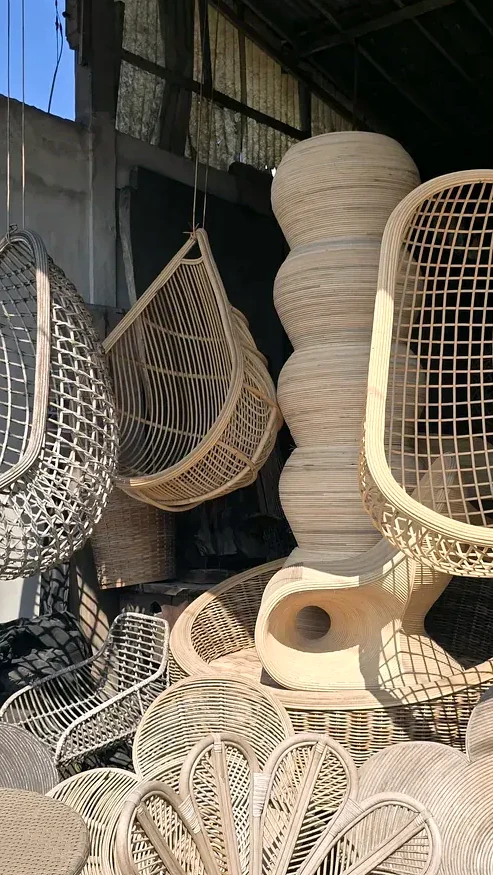
Rattan is not a tree but a climbing palm of the genus Calamus, which scrambles up rainforest trees for tens of metres. Indonesia is the largest rattan producer in the world; the raw material comes mainly from Kalimantan (the Indonesian part of Borneo), Sulawesi and Sumatra, and is processed above all on Java. Unlike bamboo, the rattan cane is solid inside, which is why it takes bending and load so well. After cutting, the canes are stripped of their thorny sheaths, dried and traditionally boiled in oil to remove sap and protect them from fungus. Two parts are worked: the smooth, glossy skin, cut into narrow strips for weaving and binding, and the core, cut into rods and round wicker-style strands. Thick canes are steam-bent, hence the characteristic curves of rattan chairs.
Bamboo: a grass that grows faster than a tree
Botanically, bamboo is a grass: it has a hollow stem divided by nodes and grows astonishingly fast. The largest species put on tens of centimetres a day, and a mature culm is cut after three to five years. In Indonesia the thick petung (Dendrocalamus asper) is used for structures and furniture, the thinner tali (Gigantochloa apus) for basketry, and black bamboo for decoration. Culms are split into strips, flattened and woven into walls, mats and baskets; heated over a fire they bend into curves. Fresh bamboo attracts powder-post beetles, so good workshops soak it in a borax solution or dry and smoke it before starting work.
Ata: the fern from Tenganan cured in smoke
Ata (Lygodium circinnatum) is a climbing fern growing at the forest edges of eastern Bali. In the village of Tenganan and around Karangasem its long, pliable runners are woven into dense, hard baskets, trays and bags. Weaving a single basket takes many days, and the finished piece is then smoked over burning coconut husks, which gives it a honey-brown colour, a faint sweet scent and natural resistance to insects and damp. We describe the technique in our article on ata baskets cured in smoke.
Water hyacinth: a weed turned material
Water hyacinth (eceng gondok, Eichhornia crassipes) is a floating plant introduced from South America that chokes lakes, canals and reservoirs on Java. Craftspeople turned the plague into a raw material: the stalks are sun-dried for several weeks, twisted into rope or braid and woven over rattan or wooden frames. The fibre is soft, matt and warm to the touch, but it absorbs moisture and is less durable than rattan; good for poufs, laundry baskets and storage, not for a chair that is sat on every day.
Pandan, lontar, raffia and seagrass: fibres from leaves
Pandan (Pandanus) leaves, once their thorny edges are removed, are boiled, dried and cut into narrow strips that have been woven into mats, hats and bags for centuries. Lontar (Borassus flabellifer) is the palm of drier eastern Bali, Lombok and the Lesser Sunda Islands; old Balinese texts were inscribed on its leaves, and today they are woven into boxes, fans and small baskets. Raffia is the fibre peeled from the young leaves of Raphia palms; it comes mainly from Madagascar and Africa, so in Indonesia it is more of an addition for binding and finishing. Seagrass, in trade terms, is usually a sedge from coastal and freshwater wetlands, such as purun (Lepironia articulata) from Kalimantan and Sumatra: a smooth, slightly glossy fibre for mats and baskets.
Fibres compared: plant, durability, character, care
| Fibre | Plant | Durability | Character | Care |
|---|---|---|---|---|
| Rattan | climbing palm Calamus; Kalimantan, Sulawesi, Sumatra | high; furniture for decades | solid cane, steam-bent; glossy skin, matt core | dusting, damp cloth; humidity 40–60%; indoors only |
| Bamboo | grass (Dendrocalamus, Gigantochloa) | high if well treated | light, hollow, noded, stiff | keep dry, away from radiators; ask about beetle treatment |
| Ata | fern Lygodium circinnatum; eastern Bali | very high; baskets last decades | dense, hard weave; smoked, honey colour | dusting, occasional damp cloth; never soak |
| Water hyacinth | Eichhornia crassipes; lakes and canals of Java | medium | soft, matt, warm; absorbs moisture | dry interiors only; soft brush; no heavy loads |
| Pandan / lontar | leaves of pandan and the lontar palm | medium | thin, flexible strips; mats, boxes, hats | keep dry, out of full sun; air mats regularly |
| Seagrass (purun) | wetland sedges; Kalimantan, Sumatra | medium | smooth, slightly glossy fibre; rustles a little | as above; not for the balcony |
| Raffia | young leaves of Raphia palms (imported) | low to medium | soft, ribbon-like, takes dye easily | decoration and binding; protect from damp |
How do you care for woven pieces in a European home?
Plant fibres, like wood, are hygroscopic: in a heated flat in winter they give off moisture, shrink and turn brittle. On Bali woven pieces live in air at 70–85 percent humidity; a Central European living room in January is often at 20–30. A few rules are enough:
- Humidify the air in winter. At 40–60 percent humidity rattan and bamboo stay flexible. Every few weeks you can lightly mist the weave with a spray bottle (do not soak it) and let it dry away from heat.
- Not by the radiator, not by the fireplace, not in full sun. Heat dries the fibre out and UV fades and weakens it; half a metre from a radiator is the minimum.
- Dust regularly. A soft brush or a vacuum cleaner with a brush attachment lifts dust out of the weave.
- Deal with stains at once. A damp cloth with mild soap, then a dry one; never submerge a basket in water or dry it on a radiator. Mould marks come off with a cloth dipped in water with a little vinegar, followed by thorough airing.
- Creaking, dull rattan is revived by a thin coat of linseed oil once every year or two; wipe off the excess. Do not oil ata, water hyacinth or pandan.
Is rattan suitable for outdoors?
Natural rattan is not. Rain and dew drawn into the fibre lead to mould and greying, sun dries and snaps it, and frost finishes the job. The same goes for water hyacinth, ata, pandan and seagrass. For a European balcony the options are synthetic rattan, polyethylene strips over an aluminium frame, or teak, which we cover in our article on teak furniture for the bathroom and garden. The exception is a covered loggia or a conservatory, where natural rattan can spend the summer as long as it comes indoors for rain and for winter.
How do you tell natural rattan from synthetic?
Synthetic rattan is not a fraud; it is a good garden material. The problem begins when it is sold as handcraft. Five checks that are enough in a shop:
- 1.Colour and repetition. Nature has shades, darker flecks and small differences in thickness; a plastic strip is identical along its whole length.
- 2.Nodes and cross-section. On a natural rattan cane a paler ring marks a node every few tens of centimetres, and a cut end shows a fibrous, spongy structure. Plastic has a smooth, uniform cross-section.
- 3.Touch and temperature. Plant weave is warm and slightly rough; plastic is cool and slippery.
- 4.Smell. Natural fibre, and smoked ata above all, smells of grass and smoke; plastic smells of nothing or of chemicals.
- 5.The frame. Synthetic rattan almost always wraps aluminium; natural rattan wraps bent rattan or wood. Tap it and lift it.
Other warning signs are in our guide on how to tell Balinese handcraft from a fake.
Why is basketry considered a sustainable material?
- Rattan grows only in living forest. It climbs trees, so harvesting it gives local communities a reason not to clear the forest; the canes regrow within a few years.
- Bamboo matures in three to five years and regrows from its rhizome after cutting without replanting.
- Water hyacinth is an invasive plant; every basket is green mass removed from a choked lake.
- Ata, pandan, lontar and purun are gathered from wild plants or home gardens, without plantations or fertiliser.
- Everything is biodegradable and hand-woven, with minimal energy use.
Sustainability is not automatic, though. Wild rattan is sometimes harvested too intensively, and some workshops bleach the fibre with sulphur. That is why we ask suppliers about the source of the material and the way it was treated, and value naturally smoked or plant-dyed fibre above bleached.
What this means for the objects in your home
When we picked up ata baskets and rattan lampshades on Bali in August 2026, what stayed with us was how differently these objects sit in the hand: ata is hard and cool like wood, water hyacinth soft like wool, rattan springs back. In our woven pieces and lamps made of natural fibres we name the fibre, because it decides whether a piece will carry weight, how its colour will age and whether it will survive a dry winter. Every object has a face, and in a woven one you can see it in every strand.
Frequently asked questions
- Is rattan the same as wicker?
- No. Wicker is the name of a weaving technique using pliable rods, not a plant: in Europe it is made from willow, in Asia from rattan core. Rattan is a specific climbing palm of the genus Calamus, used both for the rods in wickerwork and for the bent frames of furniture.
- How do I care for rattan furniture in winter so it does not crack?
- Keep air humidity at 40–60 percent, ideally with a humidifier, and keep the furniture at least half a metre from radiators. Every few weeks lightly mist the weave with a spray bottle and let it dry in the shade. Dust regularly with a soft brush, and revive dull rattan once every year or two with a thin coat of oil.
- Can natural rattan furniture stay on the balcony?
- Not permanently. Rain, dew and frost cause mould, greying and broken fibres, and full sun dries them out. For outdoors, choose synthetic polyethylene rattan or teak. Natural rattan can spend the summer on a covered loggia if it comes indoors for rain and winter.
- How can I tell natural rattan from synthetic?
- Natural rattan has uneven shades, paler node rings every few tens of centimetres and a fibrous cross-section; it is warm to the touch and smells of plant. Synthetic is a plastic strip: uniform, cool, slippery and usually woven over an aluminium frame. When in doubt, look at a cut end of the fibre.
- What is ata and how does it differ from rattan?
- Ata is a climbing fern (Lygodium circinnatum) from eastern Bali, woven in Tenganan into dense, hard baskets that are cured in coconut-husk smoke. It is thinner and stiffer than rattan, honey-coloured with a faint smell of smoke, and a finished basket resists insects and lasts for decades. Rattan is thicker, springier and used mainly for furniture.
The shop opens in autumn 2026 — the first container is being filled now.
Join the First CircleThe list shops first — 48 h before opening