Guide · Materials
Incense Raw Materials: Sandalwood, Agarwood, Benzoin and More
29 August 2026 · 8 min read
Incense raw materials are natural aromatic substances that release scent when heated or burned: woods (sandalwood, agarwood), resins (benzoin, damar), spices (clove, cinnamon) and dried flowers (frangipani, champak, ylang-ylang), bound with powdered bark of laurel-family trees and formed on a bamboo stick. Indonesia is one of the most important sources of these materials in the world: sandalwood comes from Timor, benzoin and damar from Sumatra, cloves from the Moluccas, and agarwood from the forests of Kalimantan and Sumatra.
In this article we describe each of these materials: where it comes from, what role it plays in an incense stick and how it smells. We also explain how incense made from a natural paste differs from incense dipped in fragrance oil, how to read an ingredients list, what CITES says about agarwood and sandalwood, and how to burn incense safely. In August 2026 we visited the Suputra Natural Incense workshop in Bali, where herbal incense is dried in the sun, so we also write from what we saw there.
Sandalwood: the wood that smells from the inside
White sandalwood (Santalum album) is a small tree in which only the heartwood is fragrant, the darker wood at the core of the trunk and roots. The scent comes from the santalols it contains: a warm, milky, slightly sweet note that does not irritate and lasts a long time. The tree is a hemiparasite, drawing part of its nutrients from the roots of its neighbours, and it lays down fragrant heartwood slowly: it takes several decades before the wood is suitable for distilling oil or for incense.
The historical heart of sandalwood in Indonesia is Timor and the neighbouring islands of East Nusa Tenggara province; Sumba is still nicknamed the Sandalwood Island (Pulau Cendana). Trade in this wood drew merchants from China, India and Europe to Timor long before colonisation. Centuries of felling thinned out the wild stands, so today sandalwood increasingly comes from plantations, in Nusa Tenggara, in India and in northern Australia. Incense containing real sandalwood costs more than other kinds, and very cheap “sandalwood” sticks usually smell of a synthetic substitute.
Agarwood: the resin a tree makes in self-defence
Gaharu, known in the perfume world as oud or agarwood, is not wood as such but resin-saturated tissue of trees from the genera Aquilaria and Gyrinops. A healthy tree smells faintly; only when wounded and infected by fungi does it begin to produce a dark, aromatic resin to defend itself against the infection. The longer this process goes on, the darker, heavier and more valuable the wood becomes. The scent of agarwood is deep, balsamic, woody-animalic with a hint of sweetness; in incense it is used in small amounts, as chips or powder.
Demand for oud led to wild Aquilaria trees being felled en masse, often blindly, because from the outside you cannot see which of them has produced resin. This is why all species of Aquilaria and Gyrinops are listed in CITES Appendix II: international trade requires permits. The answer has been plantations, where trees are deliberately drilled and inoculated with fungal cultures to trigger resin production in a few years instead of decades. Indonesia, alongside Malaysia and Vietnam, is among the largest producers of plantation agarwood.
Benzoin and damar: resins from Sumatra
Benzoin, kemenyan in Indonesian, is the resin of the tree Styrax benzoin, grown mainly in North Sumatra around Tapanuli. Farmers cut the bark, and the sap that flows out hardens into pale, brittle lumps that smell of vanilla, balsam and a little cinnamon. Benzoin is one of the oldest incense materials in Asia: it is burned in Malay, Javanese and Balinese rites, and in perfumery it serves as a fixative that slows the evaporation of other notes.
Damar is the collective name for resins of trees from the dipterocarp family (including Shorea) and of Agathis trees. In Sumatra, around Krui in Lampung province, damar grows in traditional forest gardens where the trees are tapped for decades without being felled. Damar smells light and resinous, with a note of pine and citrus; in incense it brightens heavier woods and helps the paste smoulder evenly.
Clove, flowers and what holds the incense together
Clove (cengkeh) is the dried flower bud of the tree Syzygium aromaticum, native to the Moluccas; Indonesia is today the largest producer of cloves in the world and also their largest consumer, mainly because of kretek cigarettes. In incense, clove gives the sharp, warm, spicy note of eugenol and supports combustion. Cinnamon, nutmeg and lemongrass belong to the same group of spices.
Flowers give incense its upper, volatile layer of scent. Frangipani (jepun) and champak (Magnolia champaca) are the temple flowers of Bali, and ylang-ylang (kenanga, Cananga odorata) is native to Indonesia and the Philippines. Dried petals are ground and added to the paste, though it helps to know that their scent when burned is gentler than that of the fresh flower; intensely “floral” sticks usually smell of added oil. In Bali the flowers in incense are also a symbol: the same frangipani lies every day in the canang sari offerings.
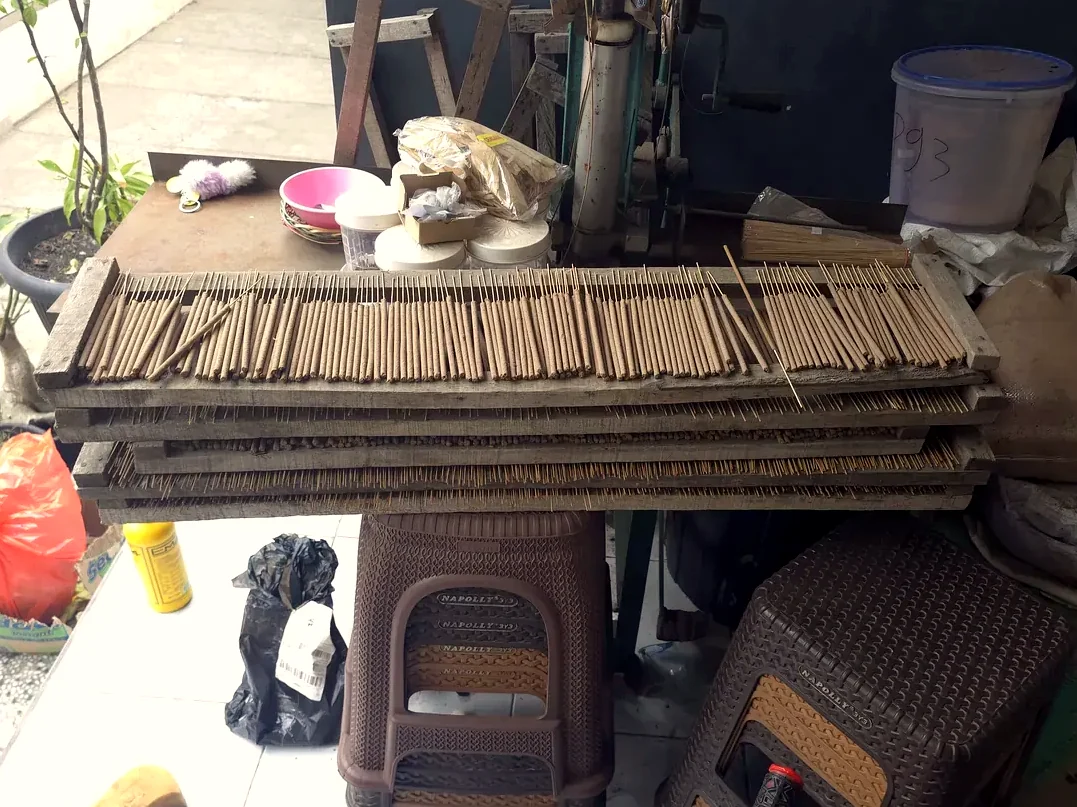
For powdered wood, resin and flowers to be formed into a stick, a binder is needed. In Asia this is powdered bark of laurel-family trees (Litsea, Machilus), known as joss powder or makko: mixed with water it becomes sticky, and when burned it is almost odourless and helps the stick smoulder evenly. Sometimes acacia gum plays this role. The paste is applied by hand to a thin sliver of bamboo, and the finished sticks are dried in the shade or in the sun, as we saw at Suputra Natural Incense, where herbal sticks were drying on bamboo trays in the courtyard.
Incense raw materials: a comparison
| Material | Plant / origin | Role in incense | Scent note |
|---|---|---|---|
| Sandalwood | Santalum album; Timor, Nusa Tenggara, plantations | woody base, main aroma | warm, milky, softly woody |
| Agarwood (oud) | Aquilaria, Gyrinops; Kalimantan, Sumatra, plantations; CITES II | accent, small addition | deep, balsamic, woody-animalic |
| Benzoin (kemenyan) | Styrax benzoin; North Sumatra | resin, fixative | vanilla, balsamic, sweet |
| Damar | Shorea, Agathis; Sumatra (Lampung) | brightening resin, even smoulder | light, resinous, pine-citrus |
| Clove (cengkeh) | Syzygium aromaticum; Moluccas, all Indonesia | spice, supports combustion | sharp, spicy, warm |
| Flowers | frangipani, champak, ylang-ylang; Bali, Java | top note, symbolism | sweet, floral, gentle when burned |
| Laurel bark (joss powder) | Litsea, Machilus; South-East Asia | binder, carrier of the smoulder | almost odourless |
| Bamboo | core of the stick; Java, Bali | structure | slightly papery when burned |
Dipped incense versus natural paste: how to read the ingredients
There are two fundamentally different methods of production on the market. In the first, the stick is made from a natural paste: powdered wood, resins, spices and flowers mixed with binder and applied to bamboo; the scent is in the paste itself. In the second, neutral, unscented sticks are produced (usually from wood dust and binder) and then dipped in a solution of fragrance oil, most often synthetic, dissolved in glycol. Dipped incense is cheaper, smells stronger before lighting and makes it possible to obtain scents that nature does not offer, but its smoke can be harsher and the fragrance fades faster. It is not bad by definition; it is simply worth knowing what you are buying. We compare the two in more detail in our article on natural versus synthetic incense.
How to read the ingredients on the packaging:
- Botanical names and specific materials (sandalwood, benzoin, clove, bark powder) are a good sign; a general “fragrance”, “parfum” or “aroma oil” with no detail points to dipped incense,
- Colour and texture — natural paste is matt and grainy, in shades of brown, beige and grey; bright, uniform colours come from dyes,
- Cold scent — a natural stick smells quietly of wood and resin; a very intense scent before lighting is usually oil,
- Price — real sandalwood and agarwood are expensive; a large pack of “oud” sticks for a couple of euros cannot contain them.
Ethics, sustainability and smoke safety
Two materials on this list need particular attention: agarwood is in CITES, and wild sandalwood has been overexploited. Responsible workshops use plantation wood from legal trade and build the rest of the paste on renewable materials: resins tapped without felling, spices from farms, flowers and bark. The question of where a material comes from is as valid here as with wooden furniture, and an honest maker can answer it.
All smoke, even from the purest sandalwood, consists of fine particles and combustion products. That is why incense is burned in a ventilated room, not in a bedroom with the window shut, not around infants or people with asthma, and never left unattended. One stick a day followed by fresh air is a different level of exposure from constant smoke all day long. We have gathered the detailed rules in our article on how to burn incense safely.
What this means for the objects in your home
The incense in our shop is made in small Balinese workshops from natural paste: powdered wood, resins, spices and flowers on a bamboo core, dried in the sun. It smells quieter than dipped incense, and that is how it should smell, because scent is meant to accompany, not dominate. How it is made and what it means in Bali is the subject of our article on the meaning of Balinese incense.
Frequently asked questions
- Is sandalwood covered by CITES?
- Santalum album is not listed in the CITES appendices, but wild stands in India and Indonesia have been heavily depleted and the export of the wood is regulated by national law. Responsible incense uses plantation sandalwood or its oil, and very cheap “sandalwood” sticks usually contain a synthetic substitute.
- What is agarwood, and why is it so expensive?
- Agarwood (oud, gaharu) is the resin-saturated wood of Aquilaria and Gyrinops trees, which produce the resin in response to wounding and fungal infection. The process takes years and only some trees produce resin, hence the price. All species are in CITES Appendix II, so legal trade requires permits, and more and more agarwood comes from inoculated plantations.
- How does dipped incense differ from natural incense?
- Natural incense carries its scent in the paste itself: powdered wood, resins, spices and flowers with a bark binder. Dipped incense is a neutral stick soaked in fragrance oil, usually synthetic. The first smells quieter and warmer, the second stronger but with harsher smoke.
- What is benzoin (kemenyan)?
- Benzoin is the resin of the tree Styrax benzoin from North Sumatra, obtained by cutting the bark. It smells of vanilla and balsam, has been burned for centuries in Malay, Javanese and Balinese rites, and serves in perfumery as a fixative.
- Is the smoke from natural incense safe?
- All smoke contains particulate matter, including smoke from sandalwood. Natural paste contains no synthetic oils or glycol, but the rules are the same: a ventilated room, moderation, no smoke around infants or people with respiratory conditions, and a stick always under supervision.
The shop opens in autumn 2026 — the first container is being filled now.
Join the First CircleThe list shops first — 48 h before opening