Guide · Indonesia & Bali
Songket and Endek: the Handwoven Textiles of Bali
1 September 2026 · 8 min read
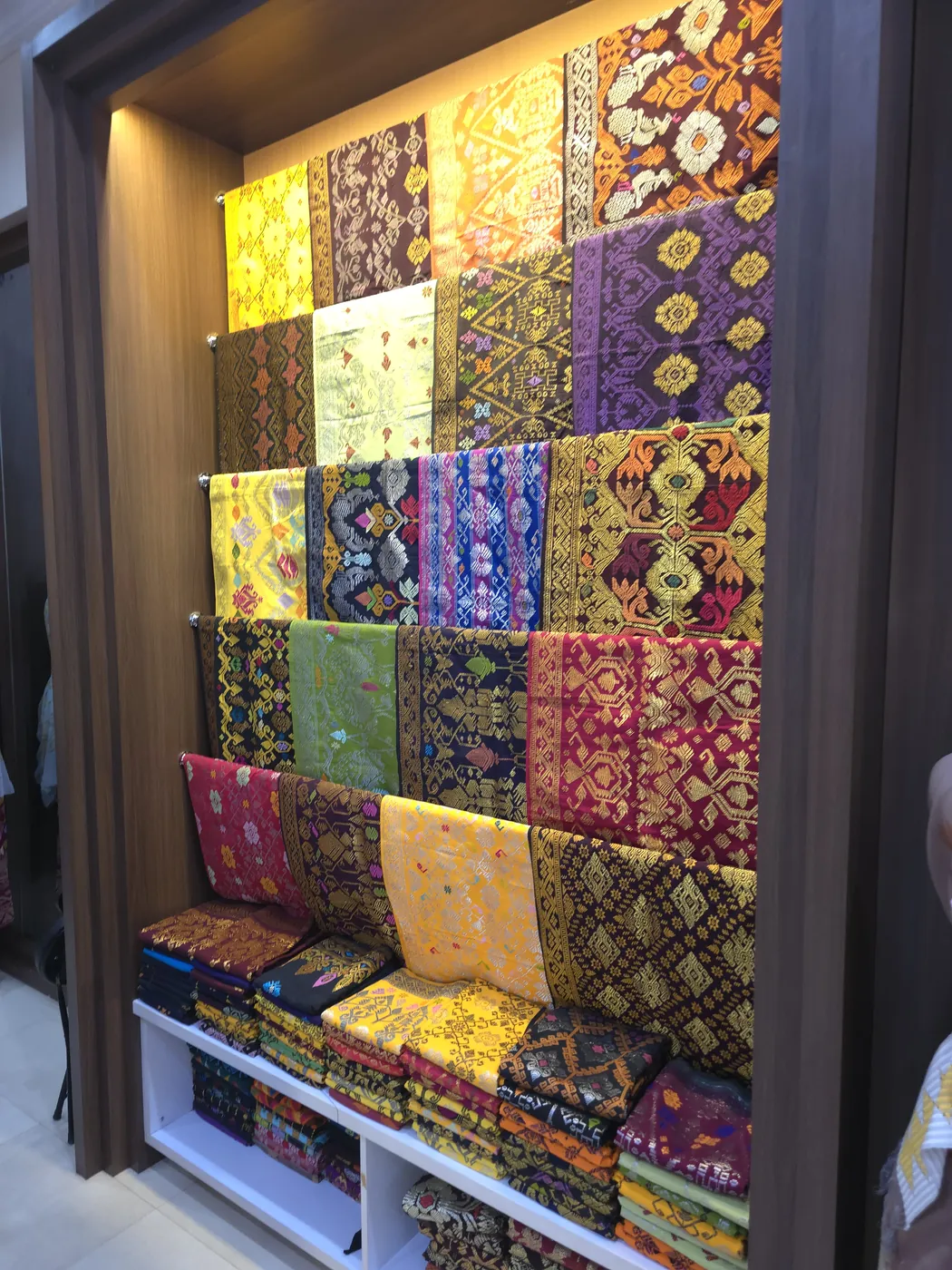
Endek and songket are the two most important textiles of Bali, both woven by hand on looms. Endek is weft ikat: the weft threads are tied and dyed before weaving, so the pattern is created in the dye bath rather than on the loom. Songket is a ceremonial cloth in which a second, decorative weft of gold or silver thread is added to the basic weave, forming a raised, gleaming pattern. Endek is worn every day and to the temple; songket is put on for weddings, ceremonies and dance.
In this article we explain how endek and songket are made, how they differ from Javanese batik and from the geringsing of Tenganan, which looms they are woven on, where the weaving centres of Bali are, what role these cloths play in dress, which fibres and dyes are used, how long a metre takes to weave, and how to care for them. In August 2026 we visited Pelangi Traditional Weaving in Sidemen and a songket workshop in Gelgel.
How is endek, or weft ikat, made?
The word ikat comes from the Malay languages and means "to tie". In ikat the pattern is neither printed nor embroidered: it is created on the threads before they are woven. In endek the weft threads (those running across the cloth) are dyed while the warp stays plain. The work goes like this:
- 1.Winding — the weft threads are wound on a frame in bundles matching the width of the cloth,
- 2.Tying — the weaver binds with string or plastic tape the sections that are to stay undyed; at this point the pattern exists only in her head and on a sketch,
- 3.Dyeing — the bundles are immersed in dye; the tied sections do not take the colour; for multicoloured patterns tying and dyeing are repeated several times,
- 4.Weaving — the dyed threads are wound onto a shuttle and passed through the warp, each row adjusted so that the fragments of pattern fall into place.
Because a thread never lands exactly in position, the edges of an endek pattern are slightly blurred, "feathered". This is not a flaw but the signature of the technique: by this soft boundary of colour you can tell real ikat from a print imitating ikat. Endek patterns are geometry, flowers, plants and stylised figures from the wayang theatre; in recent years endek has enjoyed a revival on Bali as fabric for shirts, uniforms and official dress.
How is songket, with its supplementary gold weft, made?
Songket works on a different principle. The ground cloth (silk, cotton or rayon, often dyed deep red, purple, green or gold) is woven normally, and the pattern is added during weaving as a supplementary weft: the metallic thread is passed only over selected warp threads, picked by hand or with pattern sticks inserted in advance. Every row of pattern means lifting the warp separately and passing the gold thread separately. Hence the raised, dense texture of songket and its weight.
The patterns follow a canon: plant tendrils, flowers, stars, birds, fans, fish and borders of tumpal (triangle) motifs. Songket was once reserved for the courts and the higher castes; gold thread was a mark of status. Today anyone who can afford it wears it, but the occasions remain the same: a wedding, the tooth-filing ceremony, a temple dance, the great festival at the family pura.
Endek, songket, batik, geringsing: what is the difference?
| Cloth | Origin | Technique | How to recognise it |
|---|---|---|---|
| Endek | Bali | weft ikat: dyed weft threads | soft, feathered pattern edges |
| Songket | Bali (also Sumatra, Malaysia) | supplementary weft of gold or silver thread | raised, gleaming pattern, heavy cloth |
| Batik | Java | wax applied to finished cloth, then dyed | pattern on both sides, fine wax cracks |
| Geringsing | Tenganan, eastern Bali | double ikat: dyed warp and weft | pattern built from two thread systems, years of work |
Put simply: batik is made on finished cloth, ikat on threads before weaving, songket during weaving. Geringsing is the rarest and most difficult of these techniques, woven in a single village on all of Bali; we devoted a separate article to geringsing, the cloth that takes years to weave.
Looms: cagcag and ATBM
Two types of loom are used on Bali. The cagcag is the traditional backstrap loom, with the warp tension held by the weaver's body: she sits on the ground, a strap runs behind her back and her feet brace against a beam. The name comes from the sound of the wooden beater striking the cloth. The cagcag produces narrow cloth and allows full control of every thread, which is why the finest songket is woven on it. The ATBM (alat tenun bukan mesin, "non-machine loom") is a framed treadle loom introduced to Bali in the twentieth century: faster, producing wider cloth, and used above all for endek.
Where on Bali are endek and songket woven?
- Sidemen (Karangasem) — a mountain valley at the foot of Agung, a centre of endek and of songket woven in homes; here we visited Pelangi Traditional Weaving, where cagcag and ATBM looms stand side by side in one hall,
- Gelgel (Klungkung) — the former royal capital and still a centre of ceremonial songket; we visited Dian's workshop, where the weavers work on cagcag looms,
- Singaraja (Buleleng) — the north of the island, endek and songket in a different, more colourful style,
- Jembrana (Negara) — western Bali, endek and songket, including cloths with local motifs,
- Tenganan (Karangasem) — the village of geringsing, a story of its own.
All these places are marked on our map of the craft villages of Bali.
What are these cloths used for in dress?
Balinese ceremonial dress consists of several rectangles of cloth rather than sewn garments. The kamen is a long cloth wrapped around the hips down to the ankles, worn by women and men. Men add a saput, a shorter cloth in a contrasting pattern, and tie an udeng on the head, a cloth knotted at the front. Women wear the kamen with a kebaya blouse and a selendang, a sash around the waist. Endek and songket serve precisely as kamen and saput; songket also appears as a sash or udeng on the most important occasions. Sarong, the word used with tourists, simply means a cloth wrapped around the hips.
Fibres and dyes: natural or chemical?
The traditional fibre was hand-spun cotton; court songket was woven on silk. Today most endek is made of cotton or rayon (a viscose fibre, lighter and cheaper), and songket of silk, cotton or blends, with synthetic metallic thread in place of the old gold. Natural dyes, indigo for blue, the root of Indian mulberry (mengkudu) for red, turmeric and mango leaves for yellows, give deep, slightly uneven colours that age gracefully, but they require many baths and weeks of work. Chemical dyes are faster, cheaper and more saturated. Both workshops we visited used both kinds: natural for special orders, chemical for everyday production. An honest seller will tell you which is in a given piece.
How long does a metre of songket take?
Everyone asks this, and the answer depends on the density of the pattern. Simple endek on an ATBM loom can grow by several metres a day, but preparing and dyeing the threads beforehand takes days or weeks. Songket on a cagcag is another scale: with a dense pattern the weaver advances a few centimetres a day, so a single kamen of about two metres means several weeks, and a rich wedding songket months. This explains the price: real songket costs many times more than endek, and a print imitating songket costs a fraction of either.
How to care for endek and songket
- Endek — wash by hand in cool water with mild soap, do not wring, dry flat or on a line in the shade; natural dyes may run in the first wash, so wash separately,
- Songket — do not wash. Air it in the shade and, if necessary, have it dry-cleaned by a specialist; metallic thread does not tolerate water, rubbing or wringing,
- Storage — roll rather than fold, so the gold thread does not break at the creases; put acid-free paper or clean cotton between the layers,
- Light — keep away from direct sun; UV fades dyes, especially natural ones,
- Ironing — endek through a damp cloth, songket only from the reverse with a cool iron, if at all.
What this means for the objects in your home
Balinese textiles in a European home need not be a kamen. A length of endek is a natural table runner or a throw over the back of a sofa, songket in a simple frame becomes a picture, and smaller pieces serve as cushion covers. What matters is a calm background: raw wood, linen, walls in cream and clay, as we describe in our article on Balinese style in the interior. We gather handwoven cloths from the workshops we visited in our textiles category. Each has slightly uneven pattern edges, because someone tied every thread by hand.
Frequently asked questions
- What is the difference between endek and songket?
- Endek is weft ikat: the weft threads are dyed before weaving and the pattern has soft, blurred edges. Songket is a cloth in which the pattern is created during weaving from a supplementary weft of gold or silver thread, raised and gleaming. Endek is worn daily, songket for ceremonies.
- How does Balinese ikat differ from batik?
- Batik (from Java) is made on finished cloth: the pattern is drawn in wax and the fabric is dyed. Ikat is made on the threads, which are tied and dyed before they are woven. Batik has sharp outlines and a pattern on both sides; ikat has soft colour boundaries.
- How long does it take to weave songket?
- With a dense pattern on a traditional cagcag loom the weaver advances a few centimetres a day, so one kamen of about two metres means several weeks of work, and a rich wedding songket months. Dyeing and winding the threads beforehand adds to that.
- Where on Bali can I buy real endek and songket?
- Best directly in the weaving centres: Sidemen (Karangasem), Gelgel (Klungkung), Singaraja in the north and Jembrana in the west. In a workshop you can see the looms, ask about fibre and dye, and tell handwoven cloth from a print by the soft edges of the pattern.
- How do I wash endek and songket?
- Wash endek by hand in cool water with mild soap, without wringing, and dry in the shade. Do not wash songket: air it, dry-clean if necessary, store it rolled and away from the sun, because metallic thread breaks at the creases.
The shop opens in autumn 2026 — the first container is being filled now.
Join the First CircleThe list shops first — 48 h before opening