Guide · Materials
Shells in Craft: Capiz, Cowrie and Mother-of-Pearl
27 August 2026 · 7 min read
Shells are among the oldest decorative materials of South-East Asia. Thin, translucent capiz plates replaced glass in windows for centuries, small cowrie shells were money in Indian Ocean trade, and mother-of-pearl from the inside of pearl oysters decorated furniture, weapons and jewellery. In Bali and on neighbouring islands they still go into lamps, mirrors, coasters and wall decor, today mostly from farms and fishing by-catch rather than from collecting on reefs.
In this article we explain how capiz, cowrie and mother-of-pearl differ, where the shells used in workshops come from, what the CITES convention and Indonesian law say about them, how to tell a natural shell from a plastic imitation, and how to care for a capiz lamp or a cowrie-trimmed mirror so that it lasts for years.
What is capiz, and why is it called the windowpane shell?
Capiz is the shell of the bivalve Placuna placenta, known in English as the windowpane oyster. The animal lives in shallow, muddy bays from India to the Philippines and Indonesia, and its almost circular, flat shell is as thin as paper and lets light through. Once cleaned and polished, a plate ranges in colour from milky white to warm honey, with a soft pearly sheen.
The name comes from the Philippines, where the shell was called kapis and the province of Capiz was famous for harvesting it. In colonial times capiz plates were set into wooden lattices and used in windows instead of expensive, fragile glass: they gave a soft, diffused light and withstood tropical storms better than panes. Such windows survive in Philippine houses of the Spanish era, and similar solutions were known in Portuguese Goa and in some colonial houses in Indonesia.
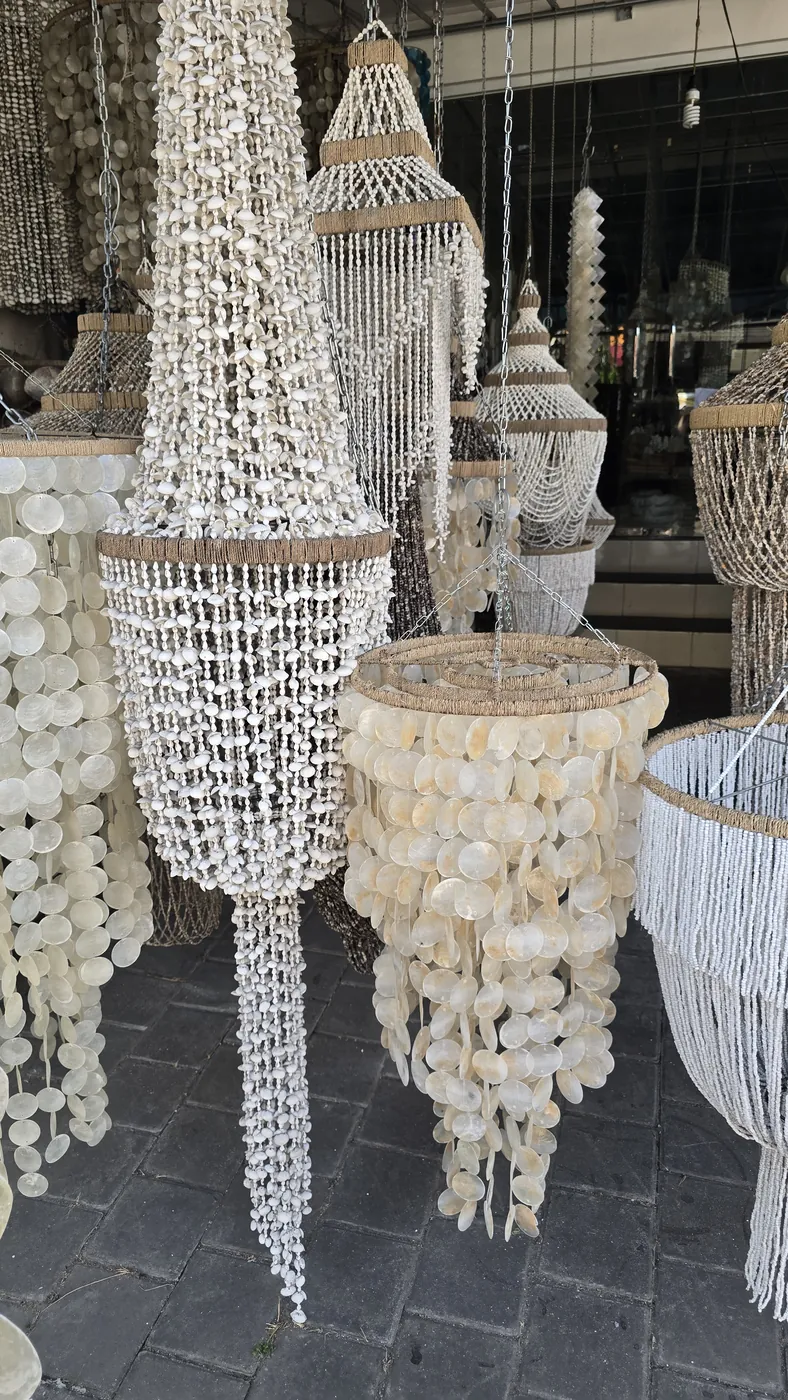
Today capiz is above all a material for lamps and chandeliers, in which dozens or hundreds of plates hung on wire move in a draught and glow warmly, and also for coasters, trays, mosaics, decorative flowers and wall ornaments. The plates are cut into discs, teardrops or petals, sometimes dyed, and then joined with wire, threaded on string or glued to mesh and a rattan frame. We say more about the woven bases such pieces often rest on in our comparison of rattan, bamboo and ata.
Cowrie: the shell that was money
The cowrie is a small sea snail, Monetaria moneta, with a smooth, porcelain-like shell and a toothed slit underneath. Its Latin name (moneta) gives away its history: for more than a thousand years cowries were currency in Indian Ocean trade, in China, India and West Africa, and the main source was the Maldives, where the snails were gathered from the shallows and dried. Merchant ships carried them by the ton.
In Indonesia and Bali the cowrie has kept its meaning as a symbol of plenty and protection. In craft it is sewn onto mirror frames, stitched along bags and belts, and woven into macramé fringes, necklaces and door hangings. Alongside the money cowrie you will find the ring cowrie (Monetaria annulus) with an orange ring on its back. Both are common, small and gathered from the shallows or as by-catch of coastal fishing.
Mother-of-pearl: the inside of the pearl oyster
Mother-of-pearl (nacre) is the inner layer of the shell of certain bivalves and snails, built from microscopic plates of aragonite, a form of calcium carbonate, bound together with protein. It is this layered structure, not a pigment, that gives it its rainbow sheen: light is refracted by successive layers and interferes. The animal deposits the same material around a grain of sand or an implanted nucleus to form a pearl.
The most important source of mother-of-pearl in Indonesia is the farming of the pearl oyster Pinctada maxima, which produces South Sea pearls. Indonesia is one of the largest producers of these pearls in the world (Lombok, Sulawesi, the Moluccas), and the shells remain after harvest as a by-product, so workshops do not need to take them from the sea. Green-blue nacre comes from abalone (Haliotis), and cream and golden nacre from large turban snails. In craft, mother-of-pearl goes into inlay on furniture and boxes, mirror frames, trays, buttons and jewellery.
Where do the shells come from, and what does CITES say?
Shells in honest craft come from three sources: farms (pearl oysters, edible clams and snails), by-catch and the waste of fish processing, and the gathering of empty, dead shells on beaches. One thing is essential: none of them should come from live animals taken off a reef just to sell the shell.
CITES, the convention regulating international trade in endangered species, does not cover shells as such. Its lists do, however, contain a few exceptions worth knowing about:
- giant clams (Tridacna) — huge reef bivalves, all species in Appendix II; their shells and items made from them need export permits,
- nautilus (Nautilus) — in Appendix II since 2017; their striped shells are a common souvenir mistake,
- queen conch (Strombus gigas) — a Caribbean snail, in Appendix II,
- reef-building corals — all in Appendix II; coral is not a shell, but it is often sold next to them.
In addition, Indonesian law protects several large species at national level, among them the triton (Charonia tritonis) and the horned helmet (Cassis cornuta), whose export is banned. Sari Bali does not use giant clams, nautilus or protected species: capiz, cowrie and mother-of-pearl from pearl farms are common, legal and need no CITES permits. Coral reefs suffer above all from warming waters, pollution and overfishing, but collecting live snails and clams adds to the damage: empty shells are homes for hermit crabs, and crushed shells become beach sand. So do not buy large specimen shells, and on holiday leave them where they lie.
How to tell natural shell from plastic
Resin imitations of capiz and film “mother-of-pearl” are getting better, but simple tests give them away, and you can do them in a shop or after unpacking a parcel:
- Coolness — natural shell is cool to the touch and stays that way for a while; plastic quickly takes on the temperature of your hand,
- Weight — calcium carbonate is denser than resin; a capiz plate is noticeably heavier than a film disc of the same size, and a piece of nacre heavier than a plastic imitation,
- Sound — two capiz plates tapped together give a clear, porcelain-like note; plastic sounds dull,
- Irregularity — shell has small differences in thickness, concentric growth lines and sometimes tiny flaws; an imitation is perfectly uniform,
- Iridescence — the sheen of nacre shifts as you change the viewing angle; a pearly print looks the same from every side,
- Edge — at a break, natural shell is layered and matt, plastic uniform and glossy.
We do not recommend the hot-needle test: it damages the piece, and on glued elements it does not give a clear answer. You will find more general guidance in our article on how to tell Balinese craft from a fake.
Capiz, cowrie, mother-of-pearl: a comparison
| Shell | Appearance | Used for | Care |
|---|---|---|---|
| Capiz (Placuna placenta) | flat, thin, translucent; white to honey, pearly sheen | lamps, chandeliers, coasters, mosaics, flowers, wall decor | dust with a soft brush, keep away from UV and hot bulbs, do not soak |
| Cowrie (Monetaria moneta) | small, smooth, porcelain-like snail; white to cream | trim on mirrors, bags and belts, macramé, necklaces | damp cloth, check threads and glue, no acids |
| Mother-of-pearl from pearl oyster (Pinctada) | smooth, rainbow iridescence; white, silvery or golden | inlay, mirror frames, trays, buttons, jewellery | polish with a soft cloth, avoid perfume and sweat, do not scrub |
| Abalone (Haliotis) | intense green-blue iridescence with dark veins | mosaics, inlay, jewellery, small bowls | as for nacre; protect from knocks, as the layers flake |
How to care for shell decor
The shell itself is durable: it is a limestone material that spent years in salt water. The weak links are the glue, wire, thread and the rattan or board backing the decoration rests on. A few rules:
- Dust — blow a capiz lamp clean or sweep it with a soft brush from top to bottom; wipe nacre with a dry microfibre cloth,
- Moisture — shells cope well, but glue and frames do not; hang in a bathroom only with working ventilation, and never soak or immerse glued compositions,
- Yellowing of capiz — with time and UV light the plates warm in colour; this is natural, but you will slow it down by not hanging the lamp opposite a south-facing window and by using LED bulbs, which hardly heat,
- Glue — refix a loose plate with clear epoxy or a glue for glass and ceramics; hot glue on a lamp can soften,
- Acids and chemicals — vinegar, lemon juice and descalers dissolve calcium carbonate; water with a drop of mild soap on a cloth is enough,
- Mother-of-pearl — dulls from perfume, creams and sweat; wipe jewellery after wearing, and treat inlay on furniture as you treat the wood around it, without abrasive pastes.
What this means for the objects in your home
A capiz lamp, a cowrie-trimmed mirror or a tray with mother-of-pearl bring light and the sea into a room, and at the same time remind you that every object has a face: hundreds of plates threaded by hand, shell after shell. In Sari Bali's wall decor and lighting we use only common shells from farms and by-catch, never protected species. How to weave them into a room is the subject of our piece on Balinese style in the interior.
Frequently asked questions
- Are capiz shells covered by CITES?
- No. Capiz (Placuna placenta) is not listed in the CITES appendices or on the Indonesian list of protected species. It is a common bivalve of shallow, muddy waters, harvested for centuries, and products made from it can be legally imported into the EU without permits.
- How do I clean a capiz shell lamp?
- Dry is best: blow it clean, sweep it with a soft brush or wipe it with a microfibre cloth from top to bottom. The plates should not be soaked or washed with acidic or ammonia-based cleaners, because the glue and wire can give way and the calcium carbonate dulls.
- Why does capiz turn yellow, and can it be reversed?
- The plates warm in colour under UV light and the heat of bulbs; it is the natural ageing of the protein that binds the shell. It cannot be reversed, but it can be slowed: LED instead of incandescent bulbs, and a spot away from direct sun. Many people prefer the honey tone of older capiz to white.
- What are cowrie shells, and where does the name come from?
- Cowries are sea snails of the genus Monetaria with a smooth, porcelain-like shell and a narrow, toothed slit underneath. Monetaria moneta was currency in Indian Ocean and African trade for centuries, hence the Latin name. In craft they are sewn onto mirrors, bags and belts.
- How do I recognise real mother-of-pearl?
- Real nacre is cool to the touch, heavier than plastic, and its sheen shifts with the viewing angle. At the edge you can see the layered structure and small irregularities. A pearly print on plastic looks identical from every side and quickly warms in the hand.
The shop opens in autumn 2026 — the first container is being filled now.
Join the First CircleThe list shops first — 48 h before opening